How to Build an Affiliate Partner Scorecard That Actually Helps You Manage the Program
An affiliate partner scorecard sounds simple until you try to build one. Put every partner in a spreadsheet, assign some points, sort highest to lowest, done.
The problem is that most of the obvious things to score are also the easiest things to misuse.
Revenue tells you who generated revenue. It does not automatically tell you who sent good customers, who has room to grow, who is one campaign away from becoming important, or who happened to catch demand that already existed. Follower count tells you even less. A partner with 100,000 followers and no believable path to your buyer is basically a very large room full of the wrong people.
A useful scorecard should answer a management question: where should I spend my time, budget and attention next?
This is how I would build one for a B2B SaaS affiliate program. It sits inside the broader operating model I cover in my B2B SaaS affiliate program management guide, but the scorecard is useful enough to deserve its own system.
A Scorecard Is Not a Leaderboard
A leaderboard answers: who sold the most?
A scorecard should answer: who is healthy, who is promising, who needs help, and who is consuming more attention than they are likely to return?
Those are different questions. If you collapse them into one revenue column, the biggest partner always wins and the interesting part of program management disappears.
Imagine two partners each generated $10,000 this quarter. One sends high-fit customers, converts consistently, responds to campaigns and is building evergreen content around your category. The other relies on branded coupon traffic that appears at the very bottom of the funnel and vanishes the moment you stop paying a premium rate.
The revenue number is identical. The management decision absolutely is not.
Start With the Decision You Want the Score to Make
Before assigning points, decide what the score will change.
- Will high-scoring partners get more one-to-one attention?
- Will the score determine who gets invited into campaigns?
- Will it help you identify partners worth reactivating?
- Will it help you decide who deserves custom terms or co-marketing support?
- Will it flag partners who need review before you keep investing in them?
If the score does not lead to a decision, it is just another dashboard number. Affiliate programs already have enough of those.
Do Not Score New and Established Partners the Same Way
This is the first place I would split the model.
A new partner cannot have six months of conversion quality, revenue consistency and customer retention data. Penalizing them for that is like giving someone a bad annual review during their first week.
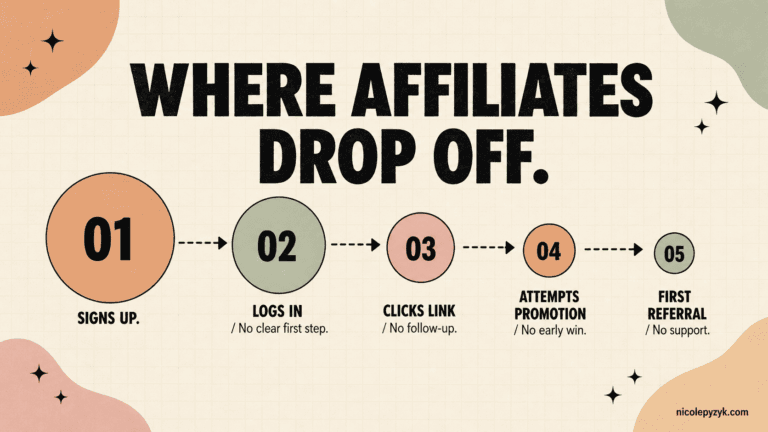
For newer partners, the score should lean more heavily on fit and activation signals: audience relevance, stated promotion plan, whether they logged in, whether they placed a link, whether they generated an early click or referral, whether they replied when someone from the program reached out.
Once a partner has enough activity, the score can shift toward actual performance quality.
If your program has a large inactive base, this distinction matters even more. I cover the reactivation side separately in how to reactivate inactive affiliates.
The Five Things I Would Score
1. Audience and customer fit
Does this partner actually reach people who could become good customers?
For B2B SaaS, I care less about raw reach than relevance. A consultant with 2,000 newsletter readers who are exactly your buyers can be more valuable than a creator with 200,000 followers who mostly care about adjacent topics.
Useful inputs might include audience role, company size, geography, problem relevance, content themes and how naturally your product fits the partner’s existing recommendations.
This is also why recruitment quality matters so much. If you are still deciding who belongs in the program, start with how I recruit and vet B2B SaaS affiliates.
2. Activation and intent
What has the partner actually done since joining?
- Logged in
- Created or placed a tracking link
- Generated a click, lead, signup or first sale
- Opened or replied to onboarding communication
- Asked for assets, clarification or campaign information
I would not treat every one of those as equally important. The point is to distinguish someone who joined out of vague curiosity from someone who is visibly moving toward promotion.
3. Quality of referred outcomes
Once a partner starts producing, this becomes one of the most important parts of the score.
Look beyond raw sales. Depending on the business, I would want to know whether referred leads qualify, whether trials convert, whether customers retain, whether refund or cancellation patterns look strange, and whether the economics still work after commission.
For high-ACV SaaS, the useful outcome might be qualified pipeline rather than immediate closed revenue. For a self-serve product, conversion and retention may tell you more. The score has to follow the actual business model.
4. Consistency
A single spike is useful. A repeatable pattern is more useful.
I would look at whether the partner contributes over multiple periods, whether they participate in relevant campaigns, and whether their performance disappears as soon as one promotion ends.
This does not mean every good partner has to produce every month. B2B buying cycles are too uneven for that. I care more about whether there is a believable pattern than whether the graph forms a perfect staircase.
5. Strategic value
This is the part a platform usually cannot score for you.
Some partners are useful beyond the revenue currently attributed to them. They rank for comparison terms you care about. They introduce you to agencies or consultants. They create evergreen educational content. They are credible in a segment you want to enter. They give you unusually good feedback on positioning because they hear buyer objections directly.
I would keep this category smaller than the performance categories so it does not become a dumping ground for vibes. But I would keep it.
Treat Compliance and Fraud as a Gate, Not a Tiny Score
I would not give compliance five points out of 100 and let a serious violation disappear inside a good total score.
If a partner is using prohibited paid search, misleading claims, fake traffic, coupon interception or another behavior your terms explicitly prohibit, that should trigger review regardless of how much revenue they generated.
Some things belong in the score. Some things belong in a red flag column.
A Simple 100-Point Example
If I needed a starting model for an established B2B SaaS program, I might begin here:
| Category | Weight | What I am trying to learn |
|---|---|---|
| Audience / customer fit | 25 | Does this partner reach the right buyers? |
| Activation and intent | 20 | Are they actually moving toward or maintaining promotion? |
| Quality of referred outcomes | 25 | Do they send business worth paying for? |
| Consistency | 15 | Is the contribution repeatable rather than accidental? |
| Strategic value | 15 | Do they create value the attribution report misses? |
That is an example, not a universal benchmark. If your program is brand new, I would increase the weight on fit and activation because there is not enough performance history yet. If you run a mature self-serve program with thousands of transactions, quality and consistency can carry more weight.
The model should change when the business changes. A scorecard carved into stone becomes wrong very efficiently.
What I Would Not Put in the Score
- Follower count by itself. Reach without fit is decoration.
- Total registrations. A partner who sends hundreds of low-intent signups can look impressive while creating very little business value.
- Raw revenue without context. Revenue matters, but so do customer quality, commission cost and incrementality.
- Email opens. Useful as a small engagement clue, not a definition of partner health.
- How much the program manager likes them. A surprisingly difficult metric to remove from human systems.
Turn the Score Into Tiers You Can Actually Manage
The useful part comes after the scoring.
I would normally translate the results into a handful of management groups, not 17 microscopic tiers.
- Core partners: proven value, strong fit, worth proactive one-to-one attention.
- Growth partners: promising signals and clear upside, but not fully developed yet.
- Maintain: healthy enough, useful broadcast communication and responsive support are usually sufficient.
- Reactivate / review: historically relevant partners whose recent activity has dropped.
- Remove or deprioritize: no credible fit, no meaningful activity, or risk that no longer justifies the management cost.
The exact thresholds matter less than consistency. If one manager calls a partner “strategic” because they like them and another requires a measurable reason, the scorecard has failed before anyone opens the spreadsheet.
Review the Scorecard on a Rhythm, Not Every Time Someone Sneezes
You do not need a live recalculation every five minutes.
For a smaller B2B program, a monthly or quarterly review is usually enough to notice meaningful movement. Fast-growing programs may need it more often. New partners can be reviewed separately during the activation window because their signals change faster.
The scorecard should make patterns easier to see, not create another maintenance job that eats the time you were trying to allocate more intelligently.
The Best Scorecard Creates a Next Action
If a partner moves from 68 to 74, I do not care unless that changes what we do.
A good affiliate partner scorecard should make the next decision obvious: call this person, invite that partner into the campaign, send this group a reactivation message, review these terms, stop spending time over here.
That is the difference between measurement and management.
If your current program is too messy to score cleanly, start with an affiliate program audit. A scorecard built on top of bad tracking, thousands of dormant accounts and unclear activation logic will mostly give you a beautifully organized version of the same problem.
B2B SaaS Affiliate Program Audit Checklist
If you cannot tell whether the real problem is partner quality, activation, economics, tracking or infrastructure, use the checklist to work through it before adding more volume.
You’ll also receive occasional B2B SaaS affiliate program notes. Unsubscribe anytime.