How Long Does a B2B SaaS Affiliate Program Take to Work?
“How long until the affiliate program starts making money?” is a completely fair question.
It is also one of those questions that gets answered with a suspiciously tidy number, usually without defining what “working” means or acknowledging that two B2B SaaS companies can have completely different buying cycles, partner types, and conversion paths.
I would not give a founder a universal three-month, six-month, or twelve-month promise. I would break the timeline into the things that actually have to happen before revenue can show up.
Those stages are the same operating system I map in my B2B SaaS affiliate program management guide, from recruitment and activation through ongoing partner management.
Revenue starts at the end of the timeline. The program starts working much earlier.
First, Define What “Working” Means
If the only definition of success is closed revenue, every B2B affiliate program looks dead for a while.
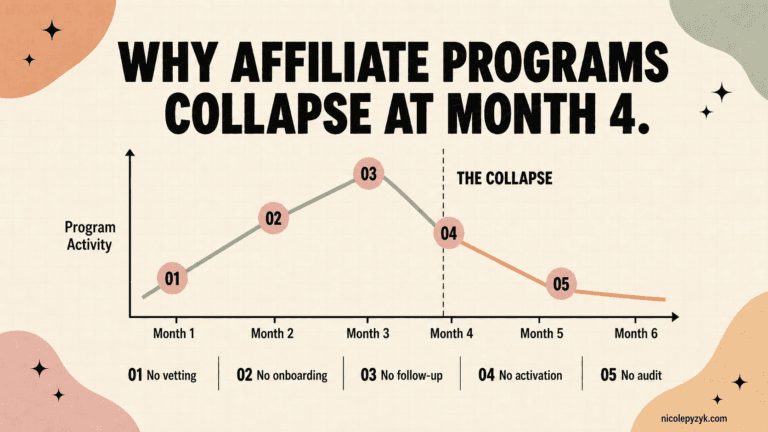
Revenue is a lagging indicator. Before a deal closes, somebody has to recruit the partner, get them approved, help them understand what to promote, get them to actually promote, generate a click or referral, create enough interest for the buyer to take the next step, and then wait through whatever sales cycle the product has.
That means I look for evidence in stages.
- Recruitment evidence: are relevant partners saying yes?
- Activation evidence: are approved partners doing something meaningful?
- Demand evidence: are those actions producing traffic, leads, trials, demos, or other buyer movement?
- Revenue evidence: are those opportunities eventually turning into paying customers?
If the first three are moving and the fourth has not happened yet, the program may not be broken. The money may simply be behind the activity.
The Timeline Is Really Four Different Clocks
The easiest way to understand time to revenue is to stop treating it like one clock.
1. How long it takes to recruit the right partners
If you already have customers, consultants, creators, publishers, or ecosystem relationships that fit the program, recruitment can start quickly.
If the company has no existing partner base, a narrow market, or a product that takes a lot of explanation, finding good partners takes longer.
This clock is affected by how specific your ideal partner profile is, whether you are doing proactive outreach, how attractive the economics are, and whether the affiliate program page gives prospects enough information to make a decision.
2. How long it takes those partners to activate
Joining is not promoting.
Some partners can move quickly because they already have a relevant article, client conversation, email list, or audience. Others need time to test the product, create content, fit it into their editorial calendar, or understand where the recommendation belongs.
A good onboarding sequence and clear enablement can shorten unnecessary delay. They cannot make a partner produce thoughtful content on command.
3. How long it takes the partner activity to create a buyer action
A consultant recommending the product to a live prospect can produce a lead immediately. A publisher building an evergreen comparison page may take longer to generate meaningful traffic. A creator introducing the category to an audience may influence demand long before your affiliate platform sees a conversion.
Partner type changes the shape of the timeline.
4. How long your own sales cycle takes
This is the part affiliate managers cannot compress with a better welcome email.
If an affiliate generates a qualified opportunity today and your normal sales process takes months, the affiliate-driven revenue will also take months to appear. Procurement, security reviews, multiple stakeholders, annual budgeting, legal review, and implementation planning do not disappear because the original lead came from a partner.
That is why comparing the launch timeline of a self-serve $30/month product with a high-ACV enterprise SaaS program is mostly useless. The businesses are running different races.
The Formula I’d Actually Use
Instead of asking “Does an affiliate program take six months?”, I would think about it like this:
Time to meaningful revenue = recruitment time + partner ramp time + time to buyer action + normal sales cycle.
Those clocks can overlap, so this is not literal arithmetic. You can recruit new partners while earlier ones are activating, and several buyer journeys can move at once.
But it gives you a much better diagnostic model than staring at the revenue column and asking why it has not moved yet.
What I’d Watch Before Revenue
Early program health should be visible before the first meaningful revenue lands.
I would watch:
- how many relevant prospects are becoming approved partners;
- how many approved partners become sales-active or promotion-active;
- time from approval to first meaningful action;
- traffic, leads, trials, demos, or referrals by partner;
- quality of those referred opportunities;
- where opportunities are sitting in the downstream sales process.
These signals tell you where the program is moving and where it is not.
A partner base that is growing but never activating is different from an active partner base sending qualified leads into a long sales cycle. Both may show little revenue today. Only one of them has an obvious affiliate-program problem.
When Waiting Is Normal
I am comfortable waiting when I can see the chain moving.
Relevant partners are joining. Some of them are promoting. Traffic or referrals are showing up. The leads make sense. Opportunities are progressing in CRM. Tracking is behaving. The commercial outcome simply has not reached the end of the sales cycle yet.
That is not passive optimism. It is evidence.
The mistake is confusing “no closed revenue yet” with “nothing is working.”
When the Program Is Actually Stuck
I get more concerned when the chain stops much earlier.
- No relevant partners are joining. Recruitment, positioning, or economics probably need work.
- Partners join and do nothing. Look at onboarding, enablement, partner quality, and the offer before recruiting another hundred.
- Partners promote but nobody responds. Audience fit, messaging, landing-page conversion, or the product proposition may be the problem.
- Qualified leads enter but never progress. Now the issue may sit downstream in sales, pricing, product fit, or the buying process rather than the affiliate program itself.
- You cannot trust the tracking. Stop diagnosing performance until you can.
This is why I like auditing the whole program rather than declaring “affiliate does not work” from one lagging metric.
What You Can Actually Speed Up
You cannot make a six-person buying committee behave like someone buying socks online. You can remove the delays your own program created.
- Recruit fewer, better-fit partners. Relevance shortens the distance between “joined” and “has a real promotional opportunity.”
- Make the first action obvious. Do not make partners reverse-engineer how to start.
- Give them usable sales material. Strong positioning, comparisons, examples, and proof reduce the work required to promote credibly.
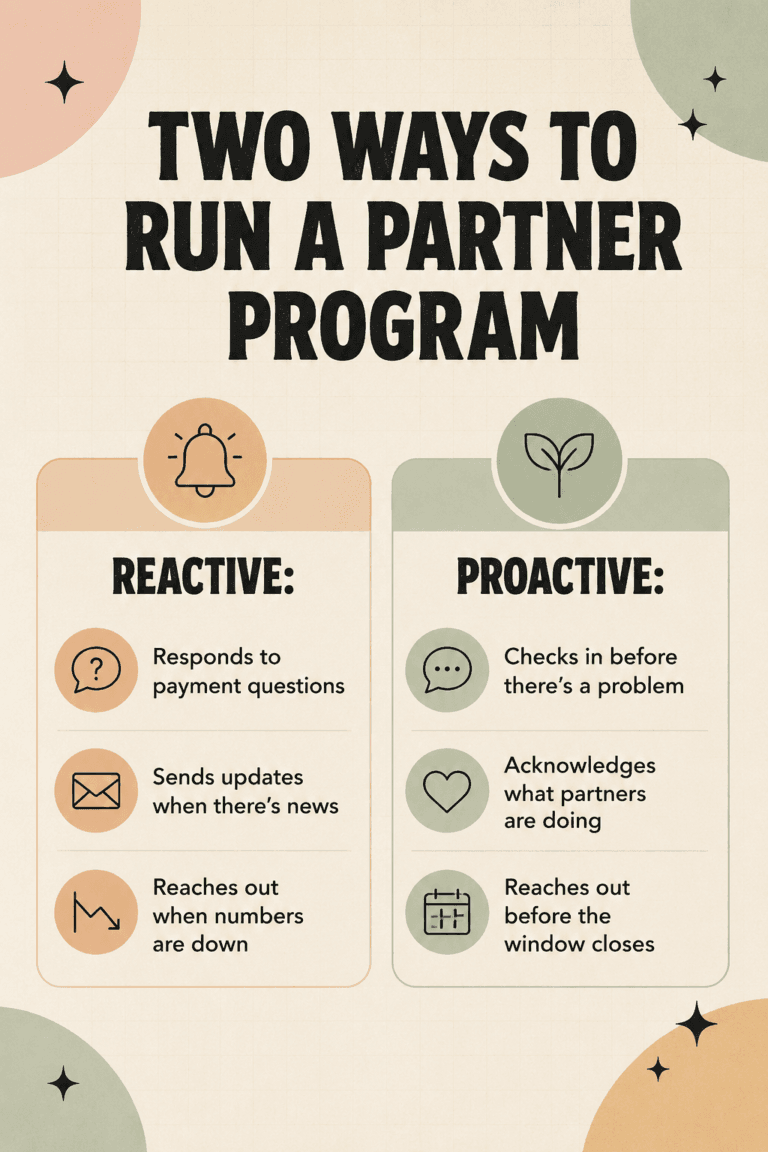
- Follow up based on behavior. A partner who is interested but stuck should not have to disappear for three months before the program notices.
- Fix tracking and handoffs. Good partner activity does not help if attribution breaks or qualified opportunities vanish between the affiliate platform and CRM.
That is operational acceleration. It is different from pretending every underlying buying cycle can be shortened.
What You Cannot Force
Some time belongs to the model.
A narrow niche has a smaller pool of credible partners. High-quality creators need time to make content worth publishing. Consultants recommend products when relevant client situations appear. Enterprise buyers move through procurement on enterprise-buyer time, which appears to be governed by a calendar unavailable to ordinary mortals.
Plan around those realities instead of punishing the program for having them.
A Smaller Active Program Can Reach Revenue Faster Than a Huge Idle One
Partner count is one of the least useful shortcuts for estimating how quickly a program will make money.
A program with hundreds of approved accounts and very few active partners can be slower than a much smaller program where the partners were deliberately recruited, onboarded, and supported.
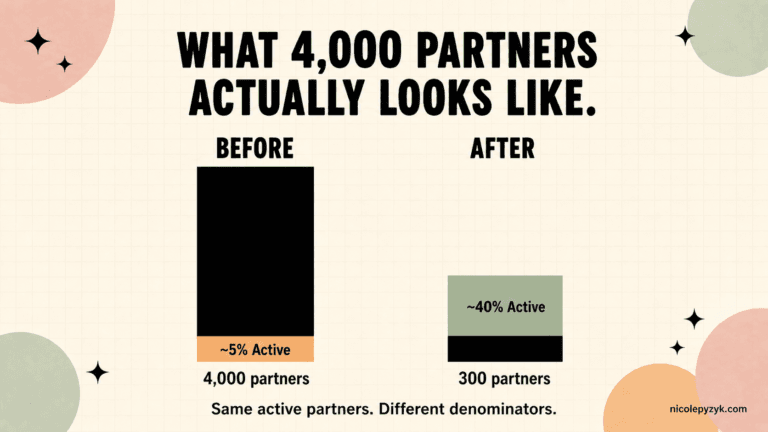
I have seen this play out directly. In one program, cutting a partner base from nearly 4,000 registrations to under 300 made the program easier to target and manage, while activation improved. The program got smaller and more effective at the same time. I wrote about that affiliate program cleanup here.
The lesson is not “delete everybody.” It is that inactive accounts do not shorten your path to revenue just because the dashboard number looks impressive.
So How Long Should You Give It?
Long enough for the real sequence of events in your business to occur.
If you know roughly how long recruitment takes, how quickly a good partner can reasonably activate, and how long the customer takes to move from referral to paid, you can build a much more honest expectation than “affiliate should work by month six.”
And once the program is live, stop asking only whether revenue has arrived. Ask where the chain is moving and where it stopped.
That will tell you whether you need patience or a fix.