Affiliate Relationship Management: What to Do After the Welcome Email
A lot of affiliate programs invest heavily in onboarding and then go quiet. The welcome sequence ends, the partner has their link, and the program manager moves on to the next recruit.
That is where the actual relationship work begins.
The welcome sequence is the handshake. The relationship starts after it.
Good affiliate onboarding gets someone from approved to oriented. Relationship management is what keeps the program present after that first burst of attention disappears. Useful communication, timely outreach, recognition, and knowing when a partner needs something different are what stop the relationship from becoming a tracking link sitting in a dashboard.
This sits inside the broader operating model I cover in my B2B SaaS affiliate program management guide.
Why Programs Break Down After Onboarding
On a return trip from Mexico, I got stuck at Madrid airport for more than ten hours. The delay itself was annoying. What broke everyone’s patience was the silence. Staff avoided eye contact, nobody gave updates, and several hundred people sat there with no idea whether the flight was happening.
Years in customer support taught me the same thing: silence breaks trust faster than the problem itself. People can deal with bad news. They struggle with feeling ignored.
Affiliate relationships work the same way. Good partners have options. They know what competing programs offer, they have limited time, and they decide where to put their attention. If your program disappears after onboarding, that decision gets made without you.
This does not mean you need to constantly “check in.” Constant communication is not relationship management. Useful communication is.
Reactive Management Fails Quietly
A lot of affiliate manager roles end up looking like this: approve applications, answer payment questions, send a newsletter when there is product news, and scramble when the numbers drop.
That is reactive management. The partner only hears from you when something needs fixing or when you need something from them. Neither one builds much of a relationship.
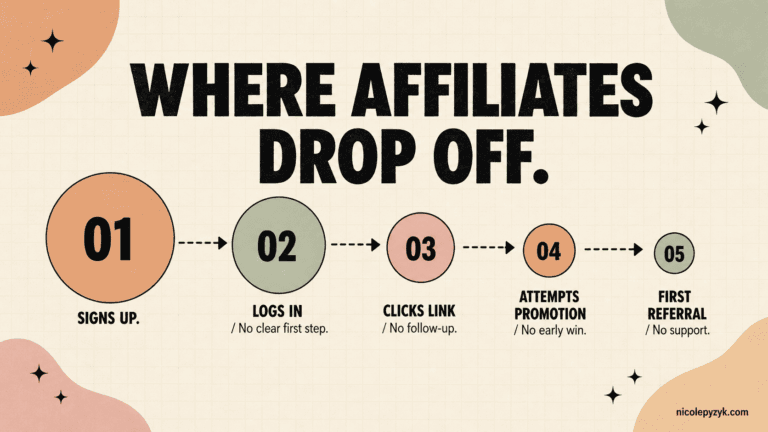
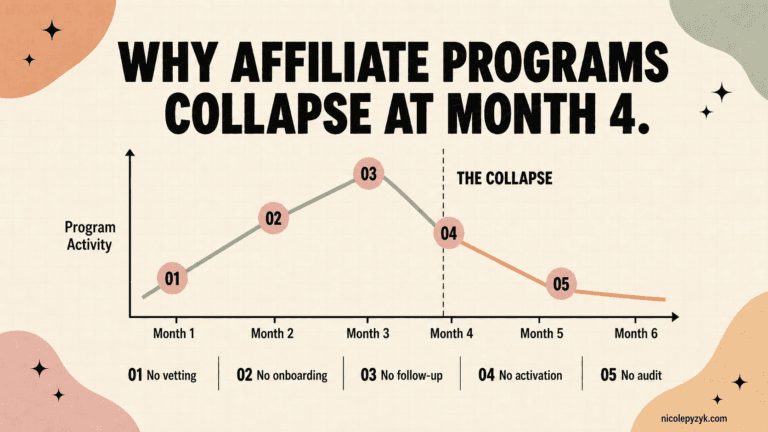
The awkward part is that partners rarely announce that they are disengaging. They do not send a breakup email. They stop posting, stop referring, stop replying, and eventually disappear into the dormant-partner count. By the time the data makes the problem obvious, the relationship has usually been fading for a while.
If you are waiting for every partner to raise their hand and tell you what is wrong, you will miss a lot of them. The ones who ask for help are often the ones already invested enough to bother.
The First 90 Days: The Relationship Window I Use
I like the first 90 days as a simple operating window because it forces the program to keep paying attention after the welcome sequence ends. It gives you three useful moments to look for friction, acknowledge progress, and decide what kind of support the partner actually needs.
Around Day 30: Make an offer, not a check-in
Do not send “just checking in.” Give them a reason to reply.
Ask whether they are set up properly and whether anything got in the way of promoting. If you have a first-sale incentive, remind them. If you have a useful asset, bring it. Then ask how they actually recommend products: publicly through content, privately through clients, inside a community, through a newsletter, or somewhere else.
That one question tells you far more about how to support someone than a generic onboarding form ever will.
Around Day 60: Acknowledge or equip
If they have been active, acknowledge it. If they have been quiet, give them something useful: a case study, a new angle, a relevant campaign, a comparison page, an integration story, or an idea that actually fits their audience.
An offer lands better than a nudge every time.
Around Day 90: Review and route
By this point I want to know whether the partner belongs in a higher-touch group, needs a different resource, would benefit from a call, or should move into a lighter-touch rhythm.
The goal is not to force activity by Day 90. It is to stop treating every partner as though they need the same thing indefinitely.
Build a Cadence That Has Something to Say
After that first window, the rhythm should become sustainable. Across the programs I manage, a simple structure is usually enough:
- Useful program updates. New assets, campaigns, commission changes, product news, positioning changes, or anything that genuinely affects how someone should promote.
- Personal touchpoints for active or high-potential partners. Reference something they did, something you noticed, or something specifically relevant to them.
- Trigger-based outreach. Respond when the partner does something worth responding to instead of waiting for the calendar.
The exact frequency matters less than whether the communication earns its place. A useless monthly newsletter is still useless because you sent it on schedule.
Trigger-Based Outreach Is Where the Relationship Feels Real
Calendar communication is the floor. The messages that actually feel personal are the ones triggered by what the partner is doing.
A partner makes their first sale: acknowledge it. They publish a piece of content featuring your product: send a note. A product update is unusually relevant to their audience: tell them directly. A campaign lines up perfectly with the kind of content they already create: give them the angle before sending a generic blast to the whole list.
These messages work because they prove someone is paying attention. That is a very different experience from being one row in a partner database.
What to Say When You Reach Out
“Just checking in” signals that you have nothing to say and are hoping the other person does the work. Affiliates get plenty of those emails and ignore them.
A useful message usually does one of three things: brings something valuable, asks one specific question, or acknowledges something the partner has done. Ideally, it does two.
The structure I use is simple: one line of context, one specific thing, and a low-friction ask if there is one. Three to five sentences is usually enough. It should read like a person wrote it, because a person did.
Subject lines are part of that. “First name + Company partner program” is technically personalized and functionally forgettable. Something like “I just tested the [Product] × [Integration] connector” gives the recipient an actual reason to open.
Usually one useful message and one thoughtful follow-up are enough to tell you whether there is a conversation to continue. Twenty touches turn you into a drip sequence wearing a name tag.
When to Book a Call
Async communication handles most affiliate relationships perfectly well. A call makes sense when the conversation becomes easier in real time.
- A strong partner has gone unusually quiet and the relationship is worth recovering.
- A high-potential new partner has not activated and there is enough upside to understand why.
- You are discussing commissions, content concerns, attribution, or anything where tone matters.
- You have a genuinely useful strategic conversation to have, rather than a meeting for the sake of having a meeting.
The bar is simple: if the conversation gets faster, clearer, or more productive in real time, book it.
Segment Attention by Value and Potential
A single communication strategy applied to the whole partner list will over-serve some people and under-serve others. Usually both at once.
I segment based on two things: what the partner is doing now, and what they could realistically become.
- Active, valuable partners deserve personal outreach, early access where useful, faster support, and a real relationship with the person running the program.
- Inconsistent but promising partners need relevant opportunities and trigger-based support, not endless “we miss you” emails.
- Dormant partners usually need diagnosis or a structured reactivation effort rather than the same relationship cadence as active partners.
Low revenue is not the same as low potential. A partner can sit dormant because the program put them there: poor onboarding, weak economics, unanswered questions, irrelevant assets, or nobody following up when momentum disappeared. Writing someone off without understanding why they stalled is how programs lose people who might have been worth the investment.
If dormancy is already a bigger structural problem, that is an activation problem, not something another generic relationship email is going to solve.
The Variable Nobody Wants to Name
The affiliate manager is a significant factor in whether partner relationships hold.
A good offer can still underperform if the person running the relationship is slow, inconsistent, hard to reach, or unable to get things done. Partners notice when questions disappear into a void, when promised assets never arrive, and when every conversation has to restart from zero.
A good manager builds context over time. They know who the partner is, what they care about, what has worked before, and when to leave them alone. That relationship survives individual campaigns because it is not dependent on one campaign in the first place.
If you own a program and performance feels inexplicably flat, it is worth asking what the partner experience of the manager actually feels like. Sometimes that explains a lot.
What Good Relationship Management Produces
In the programs I manage, the partners we stay meaningfully connected with are easier to support, easier to mobilize around campaigns, and far less likely to disappear without explanation.
A partner who hears from you when there is something relevant to say is more likely to remember the program when they are planning content, speaking to a client, or deciding what product to recommend. A partner who only hears from you when you need something learns exactly what the relationship is worth.
Affiliate marketing gets numbers-heavy fast: activation rates, commission structures, revenue per partner, conversion rates. Underneath all of it sits a channel built on human relationships.
Done well, affiliate relationship management is not high-touch theater. It is a system: useful communication, clear triggers, different levels of attention, and a manager who is actually paying attention.
For the broader operating system around recruitment, economics, activation, reporting, reactivation, and management, see my Complete Operator’s Guide to B2B SaaS affiliate program management.