The Affiliate Onboarding Email Sequence That Actually Gets Partners to Promote You
A typical affiliate welcome email delivers a wall of links, a PDF nobody opens, and a vague wish of good luck. Then the program manager wonders why new partners never share anything.
After four years managing affiliate programs for B2B SaaS companies, I’ve come to a simple conclusion: when a partner signs up and never promotes, the problem usually sits in how the onboarding communication was designed. The partner wanted to promote. That’s why they applied. Somewhere between approval and action, your emails lost them.
This article walks through the five-email sequence I use to fix that, why each email exists, and what happened when I rebuilt one of these sequences from scratch.
Onboarding is only one stage of the program lifecycle. For the wider picture, see my B2B SaaS affiliate program management guide.
Why New Affiliates Go Dormant
Here’s what happens in a lot of programs. Someone applies, gets approved, and receives a welcome email with their affiliate link and a dashboard login. Then silence. Or worse, a second email stuffed with program details they didn’t ask for yet.
The partner is left to figure out the next step alone. Some will. Many won’t.
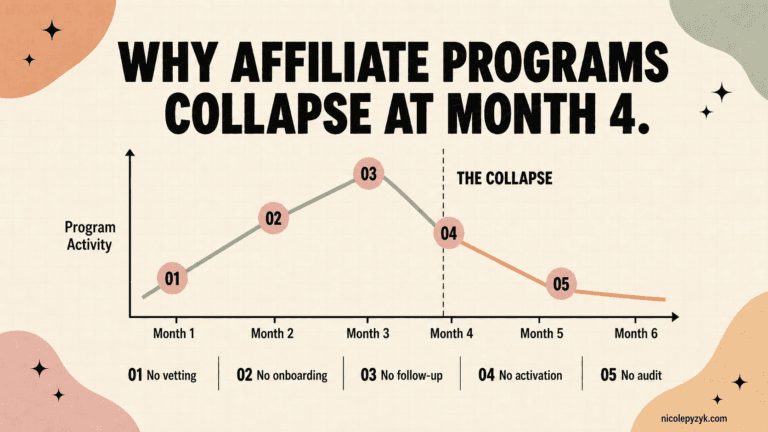
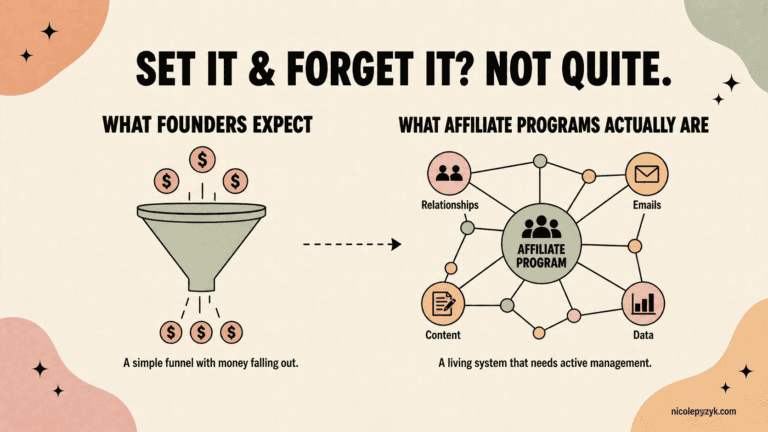
The data backs this up. In SaaS affiliate programs, only 7.6% of affiliates ever generate a referral, and just 1.28% generate a sale. Recruitment keeps filling the top of the funnel while activation stays broken underneath it.
Dormancy reflects the quality of your onboarding, far more than the quality of your partners.
What an Onboarding Sequence Is Supposed to Do
The purpose of an onboarding sequence is to get a new partner to take one action, then another, until they’ve made their first promotion attempt.
That’s the whole job. A sequence that achieves this is working. A comprehensive sequence that fails at this is decoration.
An informational sequence tells partners where the dashboard is, how commissions work, and where to find creative assets. All useful. None of it moves anyone.
An activating sequence removes the specific obstacle standing between a new partner and their first promotion. It gives them one clear thing to do, makes it easy, and follows up when they haven’t done it.
My bar for “activated”: the partner has logged in, grabbed their link, and made at least one promotion attempt. Every email in the sequence should push toward that bar.
Where Sequences Commonly Break
- Front-loading everything. A first email containing the full program manual signals that this partnership is going to be work. Think of IKEA furniture arriving as a million unlabeled pieces with no instructions. That’s how a new affiliate experiences your resource library on day one.
- No real call to action. “Log in and explore” is a suggestion. One action, stated plainly, with a direct link, is a CTA.
- Treating every affiliate the same. A content creator and a B2B newsletter operator need different angles. More on segmentation below.
- Going silent after email one. A single welcome email functions as a receipt.
The Five-Email Sequence, Email by Email
Five emails. This is the structure I come back to for the programs I manage. Here’s the logic behind each one.
Email 1: Set One Expectation
Confirm the partnership. Tell them what happens next. Give them exactly one action.
That action should be the lowest-friction step toward a first promotion, usually logging into the dashboard and finding their link. Skip the brand guidelines. Skip the resource library. One thing.
Make the subject line read like it came from a person. This email arrives when intent is highest, so spend that attention on one clear action.
Email 2: Remove the First Real Obstacle
The most common reason a new affiliate stalls after email one: they don’t know what to promote or how to position it.
Email two solves that. Give them a specific product angle, a use case that converts well, or a campaign that’s already running. Hand them the positioning instead of asking them to invent it.
“Here’s what’s working right now, and here’s how to use it” beats any amount of brand documentation.
Email 3: Give Them Something Worth Sharing
By email three, the partner has had a few days to sit with this. If they’d promoted, you’d know. What they need now is something ready-made.
Options that work: a piece of content they can share directly, a discount exclusive to their audience, or a hook tied to something timely. The goal is to reduce the creative lift to near zero. The easier the share, the more likely it happens.
Email 4: Social Proof and a Nudge
Share one short proof point. What another partner did, what’s converting, what a recent win looked like. Follow it with a low-friction next step.
This shows the program is alive and that other people find it worth their time. Keep it brief. One example, one CTA.
Email 5: The Direct Check-In
If someone has gone through the full sequence without acting, email five opens a conversation instead of pushing harder.
Something like: “I noticed you haven’t had a chance to share your link yet. Anything I can help with?” Direct, low-pressure, genuinely useful. Some partners reply with a real question. Some finally act because a person noticed. Some stay dormant anyway, and that’s fine. You did your part.
In my experience, this email gets more replies than anything else in the sequence. People respond to being asked directly.
Five emails is the starting version I come back to most often. Once it works, add behavior-triggered messages: a first-click celebration, a check-in at day 14, a final outreach at day 30 or 60. Those triggers take the sequence from functional to genuinely effective.
What Every Email Needs, and What to Cut
Every email in the sequence needs three things:
- A subject line that reads like it came from a person
- One clear CTA with a direct link
- A reply-friendly tone, written the way you’d answer if they hit reply
Cut the rest:
- Attachments and long PDFs
- Multiple asks in a single email
- Anything requiring a decision before the first action is taken
What Happened When I Rebuilt One From Scratch
One client program I managed had a welcome sequence doing what many do: delivering information. It covered the commission structure, the dashboard, the program details. It was thorough. It was also largely ignored.
I rewrote it with one goal: activation. Every email got a single job. Every CTA became one action. The tone shifted from “here’s everything you need to know” to “here’s the one thing to do right now.”
The result was double-digit engagement across opens, clicks, and replies, across the full sequence rather than just email one. Activation rate improved directly as a result.
The program content hadn’t changed. The product hadn’t changed. The partners hadn’t changed. The sequence had.
When to Segment Your Sequence
Once the core sequence works, the natural next question is whether different partner types deserve different tracks.
Yes, eventually. Hold off if you’re starting from scratch. One high-performing sequence beats three mediocre ones every time.
When you’re ready, the most useful splits are by affiliate type, such as content creators versus B2B referral partners versus newsletter publishers, or by traffic source. The logic of each email stays constant: remove obstacles, give one action, follow up. The specific angles, assets, and proof points change per segment.
Start simple. Segment when the data tells you to.
How to Know It’s Working
Watch three numbers: open and click rates across the full sequence, reply rate on the check-in email, and your activation rate within the first 30 to 90 days. Movement in those tells you whether the rebuild landed.
The welcome sequence is the first real test of whether your program respects a partner’s time. A sequence built to document will keep producing dormant signups. A sequence built to move people toward one action at a time will produce promoters, because that’s the job it was designed to do.
If most of your new partners never make a single promotion attempt, rebuild the sequence before you recruit another batch. You already have the audience. Give them a path.