The Month-Four Collapse: Why Affiliate Programs Break Where Nobody Is Looking
Your affiliate program launched well. Partners signed up, a few sales came in, and the dashboard looked healthy for a quarter. Then the activity stopped, and the usual response kicked in: more emails, bigger bonuses, new banners.
I tried all of that when I inherited an underperforming program early in my career. None of it moved the numbers, because none of it touched the actual problem.
After managing affiliate and partnership programs in B2B SaaS for several years, I’ve found the real failure usually sits in decisions made before launch. I think of month four as the point where launch energy stops doing the work for you. It won’t happen on day 120 for every program, obviously, but somewhere around that first quarter, the program has to start standing on its own.
This article walks through what tends to happen around that point, the five structural cracks behind it, and the practices that help prevent the collapse in the first place.
If you want the broader operating model behind those fixes, I cover it in my complete guide to B2B SaaS affiliate program management.
Why Month Four Is Where It Starts to Show
Here’s roughly how it plays out from a new partner’s side. The exact timing depends on your sales cycle, your product and the partners you recruit, but the shape is usually similar.
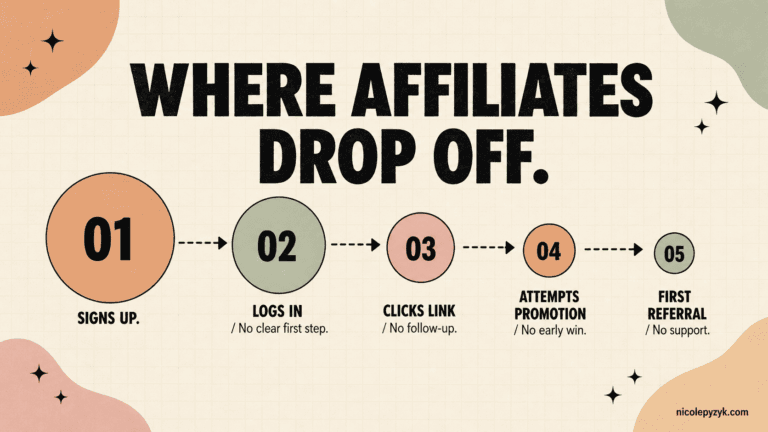
In month one, affiliates join with genuine interest. They test the product and some promote right away. In month two, the early promoters either earn their first commission or they don’t, and that single outcome splits your base into two groups. In month three, the group that hasn’t earned anything starts questioning whether your program deserves their limited time.
Somewhere around month four, a lot of them make their call. By then, the launch excitement has faded, and whatever structural weaknesses you built in at launch have had time to show up. Weak onboarding, slow payouts and unclear communication start doing real damage instead of hiding behind early momentum.
When affiliates drift away at this stage, they’re usually making a rational choice about where to spend limited time. Your job is to make staying the rational choice instead.
The Five Structural Cracks
1. Commission Structure That Ignores Your Sales Cycle
This one is easy to miss at launch and expensive by month four.
Run the math from the affiliate’s side. If your product has a 45-day sales cycle and you pay one-time commissions, a partner promotes you, waits six weeks, and sees a small payout at the end of it. If your customers churn quickly, a generous-sounding recurring rate produces very little in total earnings. Good affiliates run this math quickly, and they act on the result.
The best practice: map your commission structure to your actual customer journey before launch.
- Long sales cycles often work better with recurring commissions or milestone bonuses
- Short customer lifetimes may call for front-loaded payouts, such as a first-sale bonus plus a modest recurring rate
- Free trial products usually need commissions tied to paid conversions, sometimes with a smaller reward for the trial signup itself
The headline rate gets most of the attention, but timing matters just as much. Some affiliates are happy to wait longer if the lifetime economics make sense, and others need faster feedback to justify the effort. The longer partners have to wait before seeing evidence that a promotion can pay off, the more compelling the eventual economics need to be.
2. Onboarding Without a Clear First Action
A typical onboarding flow sends login credentials, a dashboard link, and a PDF of tips. Then it goes quiet. From the affiliate’s perspective, this feels like walking into a shop with no staff and no signage. You stand there for a minute, then you leave.
Flooding new partners with dozens of banners and a full product catalog produces the same result through the opposite route. Too many options means no obvious starting point.
Your onboarding should answer one question: what is the easiest way for a new affiliate to earn their first commission?
The best practice: build onboarding to reduce decision friction. Give them a clear starting point: the most relevant product or use case for their audience, a few proven angles, and assets they can actually adapt rather than a folder full of things to sort through. Then follow up early enough to catch anyone who gets stuck.
Different partners have different audiences and use cases, so the starting point should fit them. A review site and a consultant who implements your product for clients probably need different first steps. What matters is that nobody has to figure out step one on their own.
3. Communication That Disappears After Launch
During launch week, program managers are everywhere. Emails, Slack messages, personal check-ins. A few weeks later, the channel often goes quiet, and that silence teaches affiliates to expect nothing from you.
An affiliate once told me, after a quiet stretch in a program I managed, that they had assumed the program was shutting down. That feedback stung, and it changed how I plan communication permanently.
The best practice: communication should be useful, not frequent. I tend to use roughly monthly communication as a default for established programs, then increase frequency when there is a real campaign, change or opportunity worth talking about.
- Default for established programs: roughly monthly, when there’s something worth sharing, such as performance insights, new assets or upcoming opportunities
- Event-driven: weekly or even more frequent updates during a 30-day activation challenge, a product launch, Black Friday, a temporary incentive, a short recruitment push, or a changing promotion
During those event windows, there’s an actual reason to keep people updated. Outside of them, frequent emails get noisy and spammy fast, and partners learn to tune you out. Even the monthly update shouldn’t turn into “shit, it’s the 1st, we need to manufacture three bullet points.” If the month was quiet, a short, honest note works better than a padded one.
It also helps to separate partner communication from your own program management. Commission reviews, program reviews and performance analysis are work you should be doing regularly, but they don’t all need to become emails to your entire partner base. Share the outcome when it changes something for partners, and talk to the affected partners directly when it only matters to them.
4. Recruiting for Volume Instead of Fit
A program with 500 registered affiliates sounds impressive until you check who actually sends traffic. A smaller group of partners who genuinely reach your target customer will usually produce more revenue, with far less overhead, than hundreds of signups from a directory listing.
Affiliate revenue tends to concentrate in a small share of partners, which is exactly why fit matters more than headcount. Volume recruiting mostly adds names to a list.
The best practice: define your ideal affiliate profile before you recruit a single partner. Ask three questions.
- Where does my ideal customer go for recommendations they trust?
- What content format converts best for my product?
- Does this applicant reach that audience in that format?
If you sell project management software to remote teams, remote work bloggers and collaboration-focused review sites fit the profile. A general business blog with a loosely related audience does not, no matter how large it looks on paper.
5. No Feedback Loop
Many programs run as a one-way broadcast. You send information, affiliates may or may not act on it, and you never learn what actually helped. By month four, that can add up to a full quarter of blind spots.
My favorite question to ask partners is simple: what is the one thing that would make promoting us easier? The answers are often small, fixable items I would never have found on my own. One affiliate pointed out that our comparison chart was missing a competitor that came up in every sales conversation. Updating it took ten minutes and unblocked several deals that same week.
The best practice: build feedback into the structure. A short poll every so often, regular conversations with your most active partners, and an easy way to request assets cover a lot of it.
The Repair Plan If You’re Already Slipping
If you’re at month three, you have time. If you’re at month five, recovery takes more effort but remains realistic. Either way, diagnose before you re-engage.
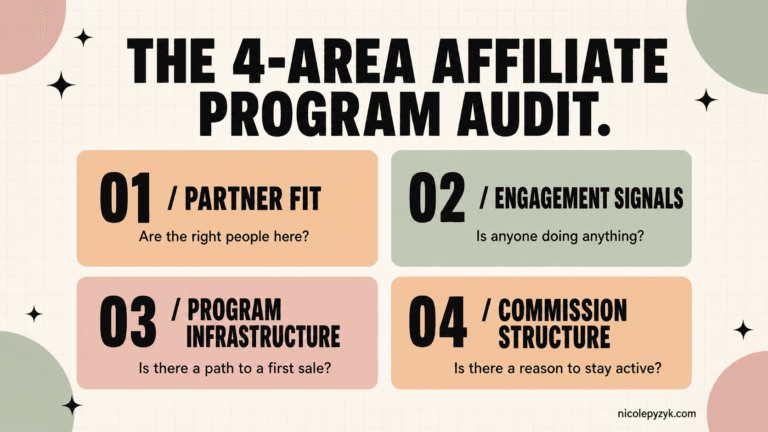
Run this quick audit first:
- Does your commission structure match your sales cycle?
- Does a new affiliate know what to do first, and can they see a realistic path to a first sale?
- Did your updates over the past 30 days give partners something they could actually use?
- Do your active affiliates reach your actual target customer?
- Do you know your partners’ biggest frustration right now?
A “no” on any of these usually means the structure needs attention before any reactivation email goes out. A generic “we miss you” message sent into a broken structure wastes everyone’s time.
Then segment your inactive base. Partners who never activated usually need a fresh onboarding sequence with a smaller first goal, sometimes as modest as a signup instead of a sale. Partners who activated and stopped deserve a direct question about what broke their momentum. Partners who produced revenue and then went quiet are often your highest-value recovery targets, and they’re worth personal outreach rather than a bulk email.
Best Practices for Building Right From Day One
A new program gives you the advantage of building the foundation correctly before anything cracks. Here is the sequence I follow now, after learning most of it the hard way.
Pre-launch: define your ideal affiliate profile, map commissions to your real sales cycle, build onboarding around a clear first action, decide on your default communication cadence and the events that justify extra updates, and set up feedback channels.
Weeks 1 through 4: recruit a deliberately small first group of well-matched partners. Stay close enough to them to see where onboarding breaks, what questions keep coming up, and which positioning actually gets used. Follow up after onboarding, watch whether they take the first intended action, and intervene when someone gets stuck. Communicate more frequently when there’s an active launch or activation campaign, but don’t manufacture updates just to maintain a cadence.
Weeks 5 through 12: settle into your default communication cadence, expand recruitment based on what you learned from that first group, and keep a close eye on activation and time to first sale.
Month four and beyond: run the first proper program review. Look at activation, time to first meaningful action or sale, concentration of revenue, dormant partners, partner feedback and the economics of the partners who are actually succeeding. The right benchmark depends on the program. What matters is whether those numbers are improving and whether you understand why.
Build for Day 120, Not Launch Day
The programs that compound aren’t necessarily the ones with the biggest launch, the most affiliates or the highest headline commission. They’re the ones where good partners can understand what to do, see a reason to keep doing it, and trust that someone is actually managing the program behind the scenes.
The recruitment push feels like progress. The big commission announcement feels like progress. The real work sits in the quieter decisions: payout timing that matches partner economics, onboarding that produces an early win, communication that’s useful enough for partners to actually read, and a feedback loop that catches problems while they’re still cheap to fix.
If activity falls off after the first few months, don’t start by recruiting another hundred affiliates. Figure out what the first hundred ran into.