4 Activation Questions for Marketers Before Influencer vs Affiliate
Pick affiliate when you need conversions you can count and a CAC you can predict. Pick influencer when you need awareness fast and someone else’s credibility to borrow.
If your quarter demands both, run them in order: influencer for reach, affiliate for the performance layer underneath.
TL;DR:
- Affiliate marketing is most effective on buyers who are already comparison shopping. You only pay when something happens.
- Influencer works top of funnel: new products, new markets, categories where nobody knows your name yet.
- Affiliate attribution is clean. Influencer attribution is a branded search spike and a lot of squinting.
- Combining both channels through sequenced campaigns and hybrid contracts can maximize reach and measurable conversions over 8 to 12 weeks.
- To improve affiliate program performance, focus on qualifying partners early, activating them, and conducting regular audits to eliminate inactive promoters.
Table of Contents
- Affiliate Marketing vs Influencer Marketing: What Sets Them Apart
- What Is Influencer Marketing, and When Does It Pay Off?
- Affiliate vs Influencer Marketing: A Side-by-Side Comparison
- When Should You Choose Influencer vs Affiliate Marketing?
- How Do You Measure ROI Without Losing the Signal?
- Building a Hybrid: Combining Influencer and Affiliate Strategies
- Ecommerce, DTC, and SaaS: Where Each Channel Fits
- What Nicole Pyzyk’s Audits Reveal About Program Execution
- Where This Is Headed in 2026
- Fix Partner Activation Before You Scale Either Channel
- Sources
Affiliate Marketing Vs Influencer Marketing: What Sets Them Apart
The split is transactional versus relational.
Affiliate marketing is pay-for-performance: A partner promotes you, you pay when a specific thing happens: a sale, a lead, a signup.
Influencer pays for reach and borrowed trust up front, whether or not anyone ever buys.
Influencer marketing is buying a round for the whole bar. Affiliate marketing is buying a drink for the person who already walked over to talk to you.
Affiliate deals run on a few different payment models, and knowing which one fits your funnel matters more than picking the “best” one:
- Cost per sale (CPS): the affiliate earns a percentage of revenue, common in ecommerce and typically ranging from 5% to 30% depending on margin.
- Cost per action (CPA): a flat fee for a specific action, like a demo booking or a free-trial signup, popular in SaaS.
- Cost per lead (CPL): payment for a qualified lead entering the pipeline, often used when the sales cycle is long.
SaaS programs tend to pay less per unit than ecommerce affiliate programs, but the lifetime value math usually favors software. A $50 CPA on a customer worth $3,000 in annual recurring revenue is a very different bet than a 10% commission on a $60 impulse purchase.
The publishers who convert best aren’t always the flashiest.
Comparison sites, coupon hubs, review bloggers, and niche newsletter writers routinely outperform social influencers on bottom-funnel intent, because the person reading is already looking for a solution, and you’re not paying for impressions that go nowhere.
What Is Influencer Marketing, and When Does It Pay Off?
Influencer marketing buys attention and borrowed credibility. You’re paying someone with an audience to put their name next to your product, betting the trust transfers.
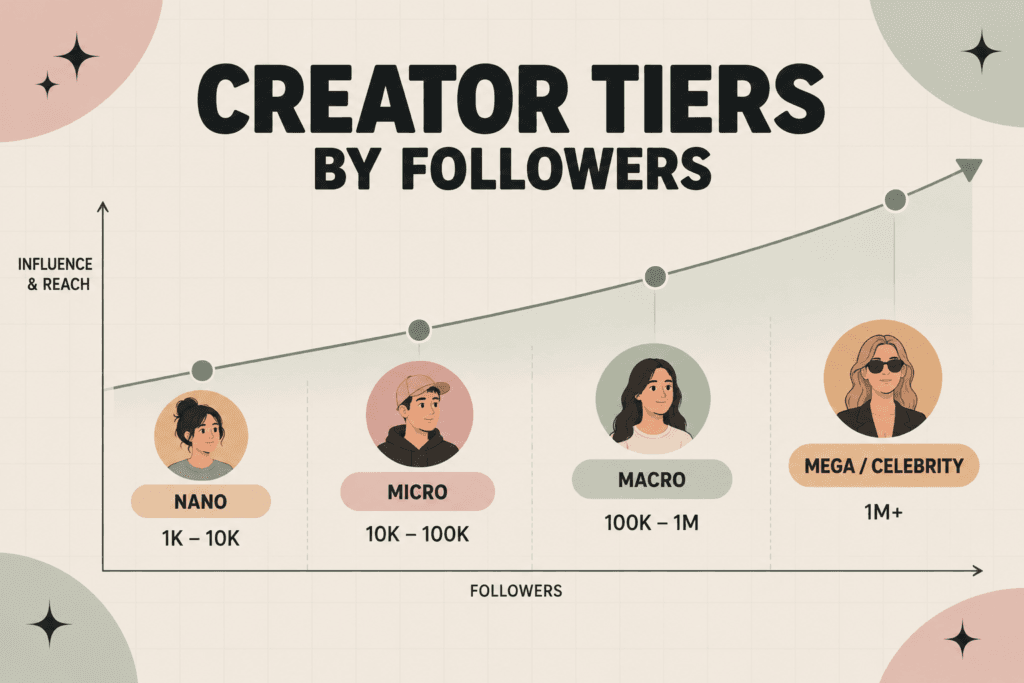
Creator tiers matter more than most brands admit:
- Nano (1,000 to 10,000 followers): cheap, sometimes paid in product, strong for niche content.
- Micro (10,000 to 100,000): the best engagement relative to cost. Smaller audiences, more invested ones.
- Macro (100,000 to 1 million): reach campaigns where volume beats intimacy.
- Mega and celebrity (over 1 million): mass awareness. Not direct response.
Payment usually comes as flat fees per post, though hybrid arrangements are becoming standard. Sprout Social found that 71% of creators offer discounts for long-term partnerships, and another 25% say they’d consider one. That negotiating room matters if you’re planning a multi-post campaign instead of a single boosted post.
Influencer is the efficient choice when you’re launching something new, entering a market where nobody knows your brand, or shifting how people see you rather than closing a sale today. Treat it like a direct-response channel and you’ll waste the budget.
Affiliate vs Influencer Marketing: A Side-by-Side Comparison
| Dimension | Affiliate Marketing | Influencer Marketing |
|---|---|---|
| Primary objective | Conversions, measurable revenue | Awareness, trust, brand perception |
| Payment model | Commission or CPA/CPL, paid on result | Flat fee per post, sometimes plus commission |
| Funnel position | Mid to bottom funnel | Top funnel, occasionally mid |
| Attribution clarity | High, via links, codes, and pixels | Low to moderate, vulnerable to dark social |
| Typical cost range | 5% to 30% of sale value, or fixed CPA | Ranges widely by tier, often $100 to $10,000+ per post |
| Best for | Predictable growth, tight CAC targets | Launches, category entry, brand storytelling |
Affiliate wins when the buyer already knows what they want and is comparing options, which is why review sites and coupon codes convert so reliably. Influencer wins when the buyer doesn’t know your category exists yet, or when trusting an unfamiliar brand is the actual barrier to purchase.
The trade-off in a line each:
- Affiliate gives you clean attribution, low upfront risk and spend that scales with results, but it’s slow to build and only as good as your partner quality and activation.
- Influencer gives you fast reach and works before launch, but the cost isn’t tied to outcome and quality swings wildly by creator.
Industry analysis backs this split: affiliate tends to be more predictable and easier to attribute, while influencer marketing wins for new-product awareness and rapid reach.
When Should You Choose Influencer vs Affiliate Marketing?
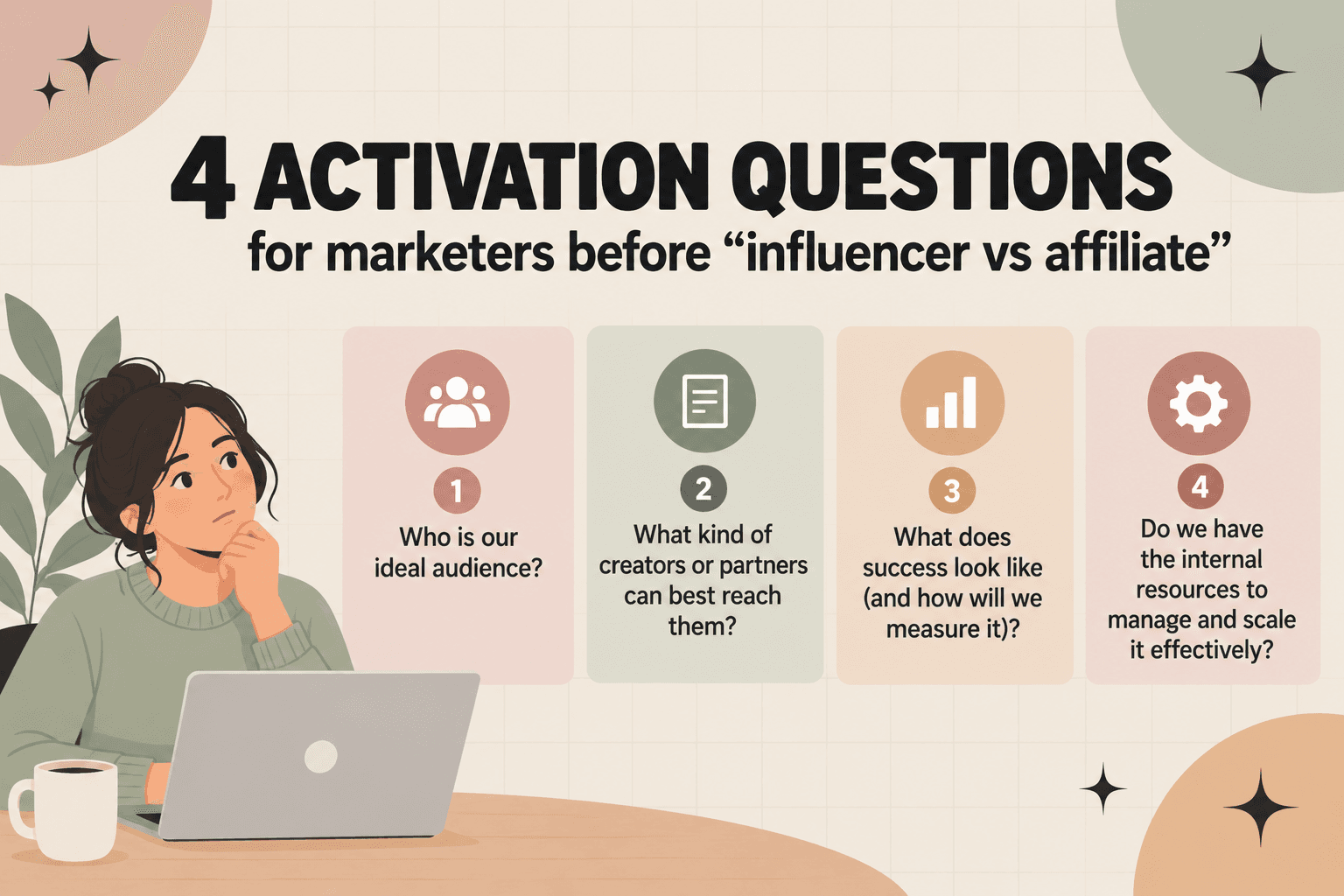
Before you commit budget, answer four questions honestly:
- What’s the actual goal this quarter? Revenue targets point to affiliate; awareness or launch goals point to influencer.
- Where’s the funnel gap? If traffic is strong but conversion is weak, you likely need better bottom-funnel affiliate content, not more reach.
- What’s your CAC target, and can you hit it with a flat fee? If cost has to scale with results, affiliate wins by design.
- Do you need custom creative, or performance links? Creative-heavy launches favor influencer; link-driven campaigns favor affiliate.
Run a short pilot before scaling either channel. Four to six weeks with three to five partners is enough to see whether affiliate converts at a sane CAC, or whether an influencer’s audience actually cares about your category.
Pro Tip: if you can’t decide which to test first, look at your last 90 days. A traffic problem is an influencer problem. A conversion problem is an affiliate problem.
How Do You Measure ROI Without Losing the Signal?
Affiliate tracking is clean by design: unique links, UTM parameters, promo codes, pixels. Every action ties back to a specific partner.
Influencer content, especially on Instagram Stories and TikTok, disappears into dark social. Someone screenshots your post, sends it to a group chat, and buys three weeks later through a branded search. Your dashboard files that under direct traffic and you get to guess.
Three things reduce the damage:
- Give every influencer a unique promo code, even on flat-fee deals, so you can measure lift without a commission structure.
- Set a view-through window of 7 to 14 days to catch delayed conversions from influencer content.
- Track branded search volume during and after the campaign. A spike is the clearest signal the content worked when clicks can’t prove it.
- Track branded search volume during and after a campaign; a spike is often the clearest signal influencer content is working when direct-click attribution can’t capture it.
Budget-wise, treat your first month on any channel as a measurement pilot, not a scaling bet.
Building a Hybrid: Combining Influencer and Affiliate Strategies
The strongest programs don’t pick one channel forever. They sequence them, and structure contracts so a single partnership can serve both goals.
- Discovery. Identify creators whose audience overlaps with your ideal customer, not just their follower count.
- Contract. Offer a flat fee for the initial post, plus a long-term commission on a unique affiliate link. This preserves authenticity (they’re not just a paid ad) while giving you trackable performance data.
- Tracking. Assign each creator a unique code or link before content goes live, never after.
- Approval. Review disclosure language and creative before publishing.
- Payout. Automate commission payouts on a monthly cycle to keep partners engaged and paid on time.
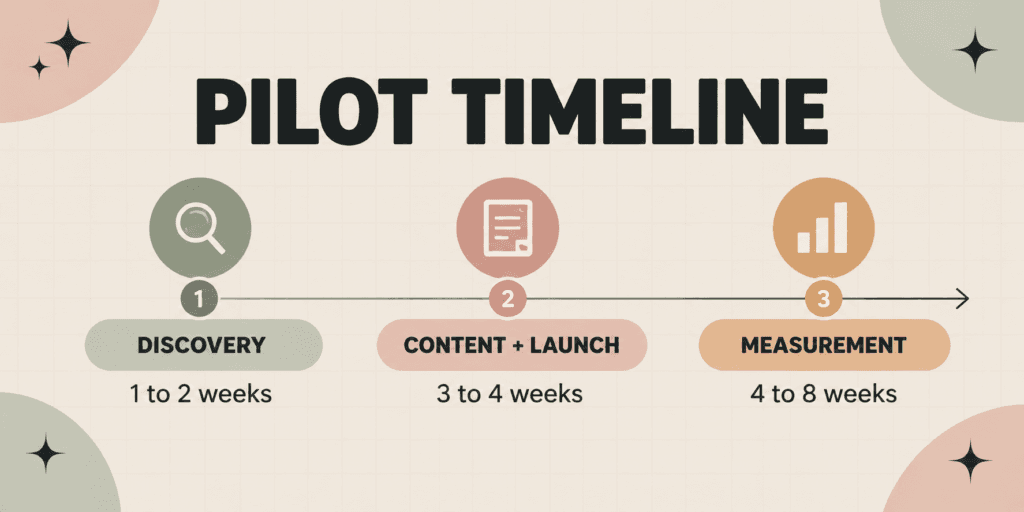
An 8 to 12 week pilot works well here: weeks 1 to 2 for discovery and contracting, weeks 3 to 4 for content and launch, and the remaining weeks tracking conversion data against a target CAC. If the commission-based link outperforms the flat fee’s implied cost per acquisition, you’ve found a partner worth a longer-term deal.
Pro Tip: Negotiate the commission rate before the first post goes live. Once a creator sees strong engagement, leverage shifts, and renegotiating gets harder.
Ecommerce, DTC, and SaaS: Where Each Channel Fits
Ecommerce and DTC lean on affiliate for seasonal pushes, coupon campaigns and comparison-site placements, with commissions tracking margin rather than a flat rate. Holiday and back-to-school are where the spend concentrates, because shoppers are already comparing.
SaaS is different. Payouts are tied to trial-to-paid conversion rather than the initial signup, which protects margin from low-quality volume. Influencer content in SaaS works as demo walkthroughs and “how I actually use this” formats. Product placement doesn’t land.
Outside North America and Western Europe, affiliate networks are thin, which pushes early-stage SaaS toward direct influencer and partner recruitment instead of a network marketplace.
What Nicole Pyzyk’s Audits Reveal About Program Execution
When I audit B2B SaaS affiliate programs, I find the same failure every time. It’s almost never a partner quality problem. People sign up, nobody follows up, and they go quiet.
What consistently moves the needle:
- Qualify partners before approval instead of accepting everyone who applies.
- Send the activation sequence within 48 hours of approval, not three weeks later.
- Prune inactive promoters quarterly. Most programs carry dead weight that wrecks their reporting.
- Audit monthly, not when revenue dips.
Pro tip: 200 partners and 15 producing revenue is not a recruitment problem. It’s an activation problem, and it’s fixable in weeks.
Where This Is Headed in 2026
Attribution scrutiny is tightening, and hybrid deals (flat fee plus long-term commission) are becoming the default rather than the exception. Waiting for perfect clarity on either channel is how you lose ground to the competitor who tested both, tracked from day one, and sequenced influencer awareness into affiliate conversion instead of treating the two as rival budgets.
— Nicole
Fix Partner Activation Before You Scale Either Channel
Most affiliate programs don’t fail because the partners were wrong. They fail because nobody activated them fast enough, and by the time someone notices, months of potential revenue are gone. That’s the gap the B2B SaaS Affiliate Program Audit Checklist is built to close.
If you’re running a SaaS affiliate program and can’t say which partners are worth your time, start with the checklist and find out before your next quarterly review.
Recommended
- Affiliate Management: Build a Partner Hub That Sells
- SaaS Marketing: Why Affiliate Programs Collapse at Month 4
- How to Find Affiliates 7 Proven B2B SaaS Recruitment
- Affiliate Program Management After Onboarding