Your Affiliate Program Probably Needs an Audit Before It Needs Another Recruitment Campaign
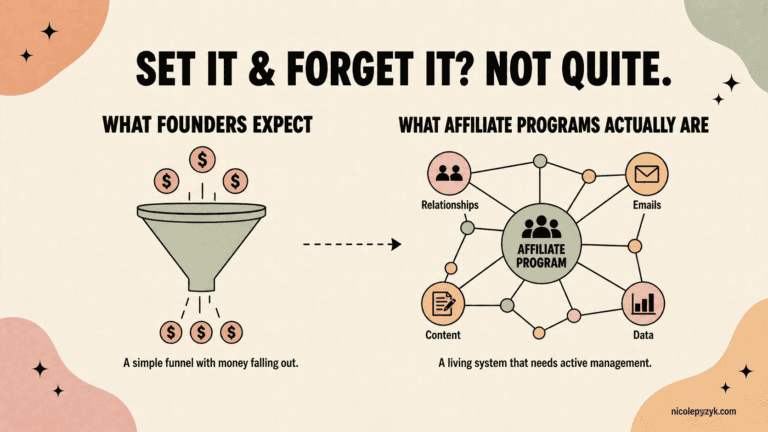
When a B2B SaaS affiliate program goes flat, the standard response is to recruit more partners. More signups create more chances at a conversion, so the logic goes. I understand the instinct. I also think it usually makes the underlying problem worse.
In my work managing affiliate programs, the programs that struggle tend to have plenty of registered partners already. What they lack is a list they can actually work with. Hundreds or thousands of names sit in the database, and only a small fraction has ever generated a click. Adding more names to that pile buries the real question deeper.
The real question is this: why aren’t the partners you already have doing anything?
Once the program is clean enough to measure properly, an affiliate partner scorecard gives you a practical way to separate core partners, growth opportunities, reactivation candidates and partners you should stop over-managing.
An audit answers that question. I want to walk through how I run one, what it looks at, and what happens to a program when you finally cut the dead weight.
The audit is one diagnostic inside a much bigger operating system. I break down that full system in my B2B SaaS affiliate program management guide.
Dormancy Is the Common Condition, and the Numbers Back That Up
Dormancy in affiliate programs runs deeper than many program managers expect. Industry research shows that only 7.6% of affiliates generate at least one referral, and just 1.28% of affiliates generate at least one sale. Fewer than 2 in 100 registered partners ever produce revenue in a typical program.
Recruitment method shapes those numbers heavily. Affiliates recruited through direct outreach activate at 50 to 70%, while partners who sign up through open registration forms activate at only 15 to 25%. A bloated, dormant list usually traces back to mass recruitment with automatic approval and no vetting.
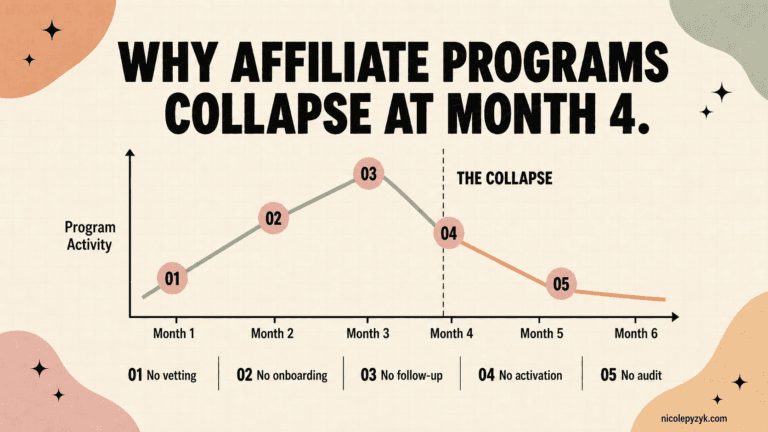
Timing matters too. Benchmarks suggest that affiliates who fail to drive a conversion within 60 days have a 3.7% lifetime probability of ever doing so. The first weeks of the relationship determine almost everything that follows. Every month a dormant partner sits untouched, the odds of recovery shrink.
So before you spend another dollar on recruitment, look at what you already have.
Two Kinds of Dormant Partners, Two Completely Different Problems
Dormant partners split into two groups, and the split matters because each group needs a different response.
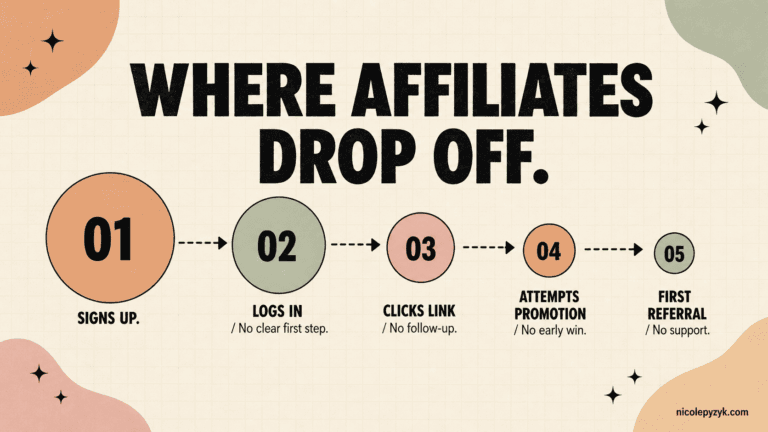
The first group signed up with real intent and disengaged because the program failed them. No onboarding, no usable assets, no clear path to a first commission. That is a program design failure. These partners may be recoverable, and fixing the program comes before any outreach to them.
The second group was never a fit. They came in through a mass recruitment push, got approved automatically, and have no audience overlap with your product. Re-engagement cannot fix a fundamental mismatch, and spending time on it drains the hours you should spend supporting partners who actually promote.
Treating both groups the same is how programs end up sending generic reactivation emails into the void and concluding that activation campaigns do not work. The campaign was fine. The segmentation was missing.
The Four Areas an Audit Actually Examines
An audit is a diagnostic process. The goal is answers, and a dashboard screenshot answers nothing. I look at four areas:
- Partner fit. Were these partners ever the right people to promote this product? Do they reach an audience that would buy it? Are they disclosing and promoting in line with FTC endorsement guidelines?
- Engagement signals. Has the partner opened an email, clicked a link, or generated a conversion in the last 90 days? Zero signal across all three is meaningful data on its own.
- Program infrastructure. Tracking links that break, outdated creative assets, confusing portals. Sometimes dormancy is a symptom of a broken program rather than a disengaged partner.
- Commission structure. If the payout is low, the cookie window is short, or the attribution model is confusing, a motivated partner has a rational reason to stay inactive. Fix the economics before you blame the people.
That last point deserves emphasis. A headline commission rate does not tell you whether the economics are attractive. Look at payout timing, recurring versus one-time commission, attribution window, customer value, sales cycle, conversion likelihood, and the effort required from the partner. Fix the economics before you blame the people.
If your structure sits well below what partners can get elsewhere, no activation sequence will compensate for it.
How to Run the Audit Without Drowning in a Spreadsheet
Pull your partner data from your platform, whether that is PartnerStack, Rewardful, Tapfiliate, or anything else. You need six columns, and resisting the urge to build forty is half the discipline:
- Date joined
- Last login, if available
- Emails opened in the last 90 days
- Clicks generated in the last 90 days
- Conversions all-time
- Conversions in the last 90 days
I set the active window at 90 days for B2B SaaS. Longer sales cycles mean you cannot expect weekly conversions, and you should still see some signal somewhere. A partner with zero opens and zero clicks in 90 days is dormant by any reasonable definition.
Then segment into four buckets: never active, previously active but lapsed, inconsistently active, and consistently active. Make no cutting decisions until the buckets exist. Each bucket gets its own response, and the consistently active bucket deserves the most attention. Those partners show you exactly what the program should optimize for and who you should recruit next. They are your design spec.
Cleaning the List Without Burning Bridges
Previously active partners who lapsed earn one re-engagement attempt. One email, one honest question, one low-friction next step. Ask what is missing that would make it easier to get started again, and offer a quick call. If the message could have gone to 500 people at once, it will read that way, and it will fail. If they respond, you have a recovery path. If they stay silent, you have your answer.
Some partners you should cut without reaching out at all:
- Signed up through a mass campaign with no personal contact
- Audience clearly misaligned with your product
- Inactive for 12+ months with zero signal across every metric
- Approved automatically with no vetting
Removing these partners costs you nothing in relationship terms, because no relationship existed. What you gain is a list you can actually run campaigns against.
What Happens to Activation Rate When You Cut
Cutting partners feels like losing ground. The registration number drops and the program looks smaller. It is smaller, and that is the point.
Activation rate is a ratio, and the denominator decides what the ratio means. With thousands of dormant names in the base, even a well-run program looks broken on paper. I ran this process on a client program where a very large registered list shrank to a fraction of its size after the audit. Activation rate improved significantly, and the mechanism was simple: the remaining partners were targetable. We could personalize outreach, run focused campaigns, and study what the active partners had in common to sharpen recruitment going forward.
The program got smaller and more effective at the same time.
That outcome repeats because a list you can reach, segment, and speak to individually is the actual asset. Raw headcount mostly hides what the program is doing. The industry median activation rate sits around 18%, with top-quartile programs reaching 31%, and the research consistently attributes that spread to onboarding effort rather than list size.
What to Do With the Partners Who Remain
Once the list is clean, activation becomes a manageable project instead of an impossible one.
Segment the remaining partners by type: content creators, agencies, complementary SaaS tools, consultants, whatever categories fit your program. Each type needs different assets and a different approach. For partners showing some signal without a conversion yet, sequenced outreach works better than a one-off email. Check in, offer something useful, ask a specific question, and move them toward a first sale.
Define “activated” precisely: at least one conversion within a set window. Opens and clicks are encouraging signals, and the activation effort works toward revenue.
Make the Audit a Habit, Not a Rescue Mission
A light quarterly review catches drift before it compounds. Check engagement signals, flag partners going quiet, and keep the list from ballooning back up. A full audit with real segmentation and cleaning decisions belongs on the calendar at least once a year, and any time the program changes significantly: new commission structure, new product tier, new ideal customer profile, new tracking platform.
The thousand-partner dormancy problem builds up over years of approving applications without vetting and running recruitment without follow-through. A regular audit prevents the buildup from restarting.
If your program’s numbers fail to reflect the effort you put in, start with the list before you change anything else. Pull the six columns this week, build the four buckets, and look at what you actually have. The answer about where your program is breaking down is already sitting in your partner data.