Rewardful vs PartnerStack: What Actually Matters for B2B SaaS Affiliate Programs
I’ve worked in both Rewardful and PartnerStack on real B2B SaaS affiliate programs, and I can tell you exactly where they start to feel different. I got so fed up trying to get basic performance numbers out of Rewardful that I ended up building a separate dashboard using its API. But I’d still recommend it for the right company, because for what it costs, it does the job.
Rewardful is a lot more direct and to the point. Connect your billing, build a campaign, decide what commission you’re paying, add partners, and get on with it. PartnerStack has more moving parts, but also gives you far more options when you want to get creative with how you manage and reward partners. That flexibility comes with an implementation process that isn’t nearly as straightforward.
My short answer: Rewardful makes it easy to launch a straightforward affiliate program. PartnerStack makes it easier to experiment with how you motivate and compensate partners as the program grows. That’s not the same as saying you can’t run a big program on Rewardful. You absolutely can. It depends on how much manual work you’re willing to do and what you actually need the platform to help you accomplish.
The quick comparison
| What matters | Rewardful | PartnerStack |
|---|---|---|
| Setup | Much more straightforward for a simple Stripe or Paddle program | More moving parts and often more technical help |
| Day-to-day reporting | Granular analysis often takes exports, manual work or the API | Easier partner/date filters and exports, but weak proactive trend alerts |
| Changing incentives | Different rates through campaigns; moving partners takes manual work or API automation | Groups, Challenges, tiers and configurable triggers |
| One-off bonuses | No simple stand-alone manual commission credit in my workflow | Manual commission directly on the partner account |
| Partner communication | Dashboard assets and external email integrations | Built-in emails, resources, groups and announcements |
| Paying partners | Export-based payouts or eligible Managed Payouts | Centralized partner payout process |
| Recruitment | Best when you recruit your own partners | Built-in B2B partner network |
Features change, and account configuration matters. Treat the table as an operational comparison, not a promise that every feature is available on every plan.
Setup: how much technical work can you absorb?
Rewardful is honestly pretty easy to get started with. Connect Stripe or Paddle, choose the currency, create a campaign, give it a name and a commission amount, then add the tracking to your website. There are plenty of prebuilt and no-code integrations, too. You don’t need to design an elaborate commission system before you’ve recruited a single partner. Their campaign setup guide walks through the basics.
PartnerStack is different. There are groups, offer triggers, commission conditions and, often, backend events that the brand’s engineers need to map properly. Some of that requires going back and forth with support. The support team has been incredibly helpful in my experience, but it’s still more work to get started. The published PlusVibe case study covers an actual migration, including the technical work on the brand’s side. For a simple commission program, I completely understand why someone wouldn’t want all that complexity.
I wouldn’t decide based on the advertised time to launch. I’d map the customer and transaction events, refunds, plans, currency, and existing partner records before signing anything. A platform migration can expose tracking problems, but it can also create ugly reporting differences if you’re counting the old and new records together.
Activation: what can you do without another tool?
This is where I personally start to prefer PartnerStack. I want to be able to try things. A first-sale bonus, a temporary challenge, different commission tiers, an extra reward for bringing in new paying customers. PartnerStack gives me groups, triggers, Challenges, resources and partner emails in one place. The setup can be fiddly, but once the logic is in place, I don’t have to manually move everybody around every time I want to test an incentive.
Rewardful offers affiliate assets in the dashboard, and it supports connecting campaigns to external communication platforms. Its campaign syncing documents integrations such as MailerLite and Customer.io, where tags or groups can drive automated messaging. So saying Rewardful has no way to communicate with affiliates would be misleading. The difference is the amount of orchestration you can handle natively, and how many systems you want to maintain.
For a founder who sends a personal note to ten active consultants, simple is plenty. For a manager experimenting with first-sale bonuses, separate groups and tier movement, I’d rather have the more extensive controls.
Commission flexibility: this is where it gets annoying
Here’s the problem I kept running into with Rewardful. I could set up different commission rates, sure, but that meant creating separate campaigns and moving partners between them. Want to give someone a better rate because they’ve reached a certain level? Move them. Want to offer everyone a temporary extra 10%? Move them into another campaign and then move them back. If you’re managing a lot of people, that’s a pain in the ass.
And it’s not that Rewardful has no way to do it. It supports multiple campaigns and you can even automate campaign moves through its API. But in the interface, you’re still doing the moving yourself. Another important wrinkle: when you move a partner to another campaign, the commission rate on customers they referred under the previous campaign stays tied to that original arrangement. So a short-lived promotion needs some thought about what happens to those new referrals afterward.
Then there’s the type of deal. Say I agree to pay a YouTuber $500 for a video, plus their usual affiliate commission. In the Rewardful workflow I’ve used, I can’t just credit an arbitrary $500 manual commission to that partner’s balance. I have to arrange the flat payment separately. PartnerStack lets me add a one-off manual commission and include it in the normal partner payout cycle. It’s a small feature until you’re the person trying to reconcile everything.
I’ve also asked Rewardful support about paying partners for things like free signups, qualified leads or clicks rather than a customer payment. For the setup we were discussing, they told me that wasn’t supported. Rewardful’s normal commission logic is built around paid invoices or charges. PartnerStack is much more flexible about rewards for different events, although the integration has to pass the right information. I wouldn’t assume every custom payout model works out of the box.
This stuff matters because I’ve had high-performing partners tell me they weren’t interested in creating more content or bringing in new customers. They were already making money from renewals. From their perspective, why put in more work if there’s nothing else to work toward?
I got on calls, talked through what they could potentially earn, and tried to find out what would make things more interesting for them. But without an incentive I could actually offer within the program’s setup, there wasn’t much I could do. Some simply weren’t interested, and we had to focus on other partners. I’d much rather be able to test a bonus for new business or a higher tier once someone hits a meaningful target.
PartnerStack’s Challenges, groups and triggers don’t magically motivate everybody, but at least they give me more to work with. I can reward a specific action without having to rebuild the whole program around it.
Payouts: don’t use an outdated comparison
I used to associate Rewardful with exports and manual commission payment workflows. It still documents those methods, including PayPal and Wise-compatible exports. But in 2026 it also documents Managed Payouts: eligible merchants fund one payout and Rewardful distributes commissions. That matters.
According to Rewardful’s onboarding documentation, the managed option requires a USD program, an eligible ACH-capable funding account, and a 3% payout processing fee. Confirm availability for your company before building a finance process around it.
PartnerStack handles central payouts too, and I love being able to include a separate manual bonus with the normal commissions. To me, that’s the distinction: paying affiliates is one question; being able to credit whatever legitimate reward you’ve agreed with them is another. The comparison is no longer just ‘PartnerStack automated, Rewardful manual.’ Rewardful’s Managed Payouts is real, but the flexibility of the commission workflow still matters.
Recruitment: the network changes the equation
PartnerStack’s B2B partner network is a meaningful advantage if you actually intend to recruit through it. There are consultants, publishers, comparison sites and other partners who already know the platform. That removes onboarding friction.
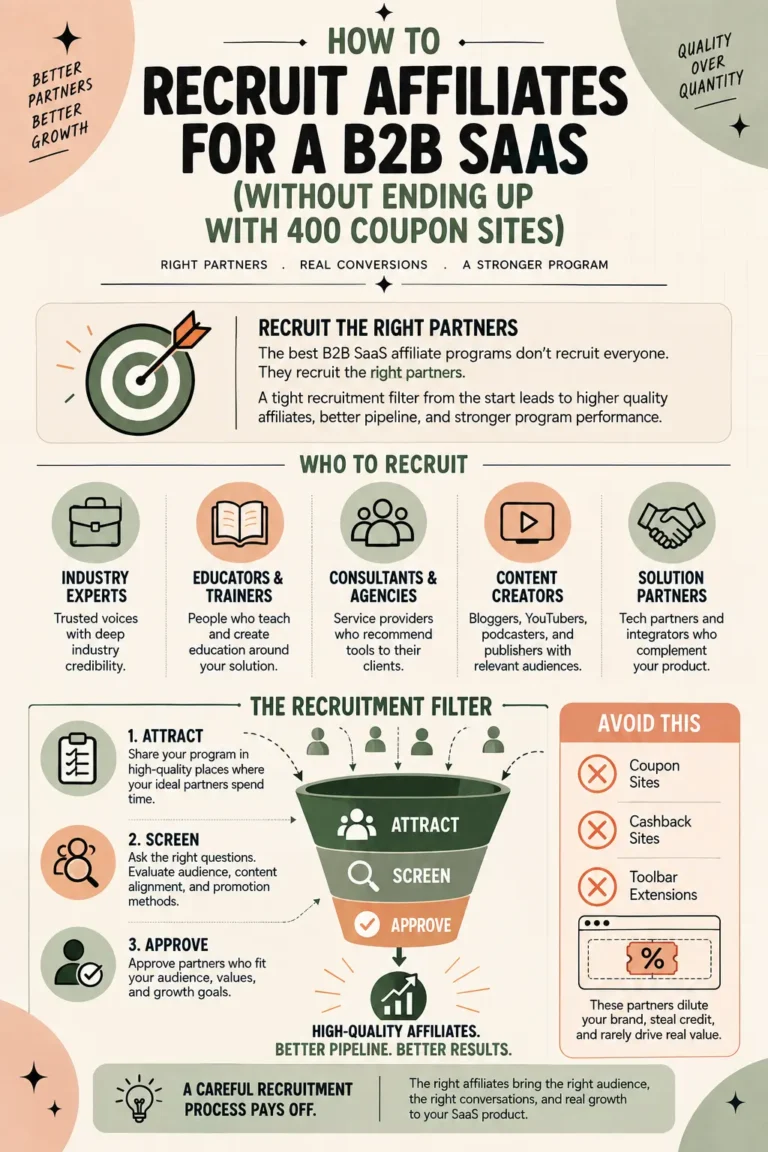
But I don’t treat the network as a vending machine for good affiliates. It also attracts applicants who join everything and have no obvious plan for your product. You’ll still need to screen their audience, promotion method and legitimacy. I’ve written separately about recruiting B2B SaaS affiliates without turning the partner database into a collection of coupon pages.
Rewardful can be perfectly workable if you already know the partners you want, or recruitment happens through your customer base and direct outreach. I wouldn’t pay a large premium for a network that nobody on the team has time to use.
Reporting: neither dashboard tells you the entire story
Rewardful is the part that drives me crazy. Sometimes I just want to know how many free signups and how many paying referrals we had today, or this week, or what a particular partner did over a specific period. I shouldn’t need a separate spreadsheet to answer that. But in the Rewardful interface I’ve been using, granular reporting is genuinely frustrating.
Even inside an individual partner profile, I can’t easily filter the history by the dates I want. For free signups (the leads rather than paid conversions), I’ve had to go into the Referrals list and literally count pages of 25 results because I couldn’t export that list from the interface. Sales can be exported, but the files take time to clean up, include plenty of columns I don’t need, and the amounts have arrived in cents rather than dollars. If you’re just trying to answer a basic question, it gets old very quickly.
I eventually built an entirely separate dashboard using Rewardful’s API because getting the data into a useful format through the interface was that much of a pain. So the data is there, and the API gives you options. But if I have to build my own reporting layer to see what happened last Tuesday, that’s still a limitation of the day-to-day experience.
PartnerStack is considerably easier for basic analysis. I can go into the Partner Performance report, filter by a particular partner and date range, see the numbers, and export them. That is the kind of thing I want to be able to do without thinking twice. Its reporting docs cover those filters and exports.
But here’s what I still wish PartnerStack would do: tell me who needs my attention before it’s too late. I want an obvious flag for partners whose signups are dropping, whose new paying customers are declining, or who are nearing the end of their first 30 days without doing anything. I want to see who is suddenly growing, too. And I’d love clearer comparisons between specific periods, such as the first week of October this year versus the same week last year, without doing the detective work myself.
PartnerStack has month-over-month and year-over-year reports, and it can group performance by period. I’m not saying the data doesn’t exist. The issue is that once you’ve got hundreds of partners, a report full of totals doesn’t automatically show who is starting to churn. A partner might still be earning from existing subscriptions while their new customer acquisition has quietly fallen off. That’s the problem I want to catch.
For a long time, I was exporting data and keeping spreadsheets to spot changes. I tried PartnerStack’s MCP when it launched and didn’t find it especially useful for what I needed. I briefly tried Claude Code too, which was better in some ways but slow and occasionally confused. I’ve now set up an internal AI-assisted workflow that checks the programs I manage twice a week, identifies potential declines and opportunities, and prepares partner outreach for my approval. It also tracks what happens afterward, with new customers and new revenue kept separate from renewals.
That workflow only started in October 2026, so I don’t have results to claim yet. And its estimates of how partners might have performed without outreach are just estimates, not proof that a particular email caused extra sales. But the fact that I’ve had to create a separate process for this tells you what I think is missing from the platform.
Ultimately, I don’t want a prettier chart. I want to know which partners should I speak to this week, and why? For comparing partner quality beyond total revenue, I also use a partner scorecard and the billing data where necessary.
Cost: compare the annual reality, not the starting sticker
PartnerStack pricing generally requires a sales conversation and a quote. The Affilial team has seen contracts in the low five figures annually, before commissions, but that is experience from particular client programs, not a published universal price.
Rewardful is just in a completely different price bracket. As of October 2026, its public pricing starts at $49/month for Starter (up to $7,500/month in affiliate-attributed revenue), $99/month for Growth (up to $15,000/month), and $149+/month for Enterprise. There are limits and plan differences, so check the tier you’d actually need. PartnerStack is quote-based and, from the programs our team has worked on, the commitment has been in the low five figures annually before partner commissions. That’s a serious difference. But I wouldn’t compare just the subscription price. I’d also count:
- Platform subscription and implementation costs.
- Transaction or network-sourcing fees, plus payout processing.
- Hours spent paying partners, resolving tracking issues and building workarounds.
- Any additional communication, CRM or reporting tools required.
- Expected value from features someone will truly use, not features in a sales demo.
Which would I choose?
I’d choose Rewardful if I wanted to get a straightforward SaaS affiliate program live without complicating my life or spending a fortune on software. If I’m mainly paying a percentage of subscriptions, the partner base is manageable, and I don’t need elaborate bonuses or reporting, it does the job. I wouldn’t move just because another platform looks more sophisticated.
I’d choose PartnerStack when a company is serious about turning partnerships into a bigger revenue channel and actually has someone running it. I want to test different commissions, reward new business, give strong partners something to work toward, see individual performance without a reporting headache, and have the flexibility to try new things. It still won’t do the thinking for me, and I still wish its reporting were more proactive. But I can do considerably more with it.
What I wouldn’t do is sell a founder on PartnerStack because it’s expensive and therefore must be better. If their website doesn’t convert, the product isn’t ready, or nobody has time to manage partners, switching platforms isn’t going to fix any of that. I’d audit the program first.
Disclosure: This is my own comparison based on using both platforms to manage real affiliate programs. I also contributed to Affilial’s PartnerStack review, for which PartnerStack paid Affilial a flat fee. I wasn’t personally paid for that review. This article has not been sponsored and does not contain affiliate purchase links.