4 Questions to Answer Before You Choose Influencer or Affiliate
“Influencer or affiliate?” sounds like a channel question. Most of the time, it is actually a goal, economics, and measurement question wearing a channel-shaped hat.
Affiliate and influencer partnerships overlap more than people like to admit. An affiliate can introduce a product to an audience that has never heard of it. A creator can drive measurable conversions through a tracked link. The difference is not that one owns awareness and the other owns revenue.
The useful distinction is what you are asking the partner to do, what you are willing to pay for, and how much outcome risk you want to carry.
The useful question is not influencer or affiliate. It is what are you paying this partner to do, and how will you know it worked?
What Actually Separates Influencer and Affiliate
Affiliate relationships are usually structured around an outcome. A partner refers a sale, qualified lead, demo, signup, or other agreed action, and compensation follows the result.
Influencer relationships are usually structured around the content or distribution itself. You pay for access to an audience, the creator’s voice, and the work required to produce and publish something, whether or not a conversion happens immediately.
Think of influencer marketing as buying a round for the whole bar. Affiliate marketing is buying a drink for the person who already walked over to talk to you. It is not a perfect analogy, because humans insist on ruining every clean framework by behaving unpredictably, but it gets the economic difference across.
That distinction matters more than follower count, creator labels, or whether someone calls themselves an “influencer” in their bio.
In B2B SaaS, I care far more about audience relevance and influence over buying decisions than creator tier. A consultant with a few thousand highly relevant followers can be more commercially useful than a creator with a much larger general audience.
1. What Are You Actually Trying to Buy?
Start with the outcome before you start with the channel.
If the job is to introduce a new category, launch something unfamiliar, borrow credibility from someone your buyers already trust, or create content you would struggle to produce yourself, a paid creator partnership may make sense.
If the job is to reward partners for measurable business they influence or generate, affiliate economics may make more sense.
The mistake is choosing “influencer” because you want awareness or “affiliate” because you want revenue without defining what that actually means. Awareness of what? Revenue from whom? Over what buying cycle? Through what type of partner?
Write the goal down before anyone sends you a creator list. The list will look exciting either way.
2. Where Is the Actual Constraint?
If nobody in your market knows you exist, paying more partners to capture existing demand probably will not solve the problem. You need more qualified people entering the consideration set in the first place.
If plenty of the right people already know the product, compare it, visit high-intent pages, and ask peers about it, buying more reach may not be the first thing you need. You may get more from partners who help buyers evaluate, compare, recommend, or convert.
This is why I do not love the shortcut “influencer is top of funnel, affiliate is bottom of funnel.” It is neat enough to fit in a slide and wrong often enough to be dangerous.
A niche newsletter affiliate can create discovery. A YouTube creator on a flat fee can drive direct purchases. A consultant can do both in the same conversation.
Look at the constraint, not the label.
3. How Much Outcome Risk Can You Accept?
This is where the economics become much clearer.
With affiliate compensation, more of the performance risk sits with the partner. You generally pay when the agreed result happens. With a flat creator fee, more of the risk sits with the brand. You pay for the work and distribution even if the commercial result is weak.
That does not make affiliate “cheap” or influencer “risky.” It means they price different things.
Affiliate also does not magically make customer acquisition cost predictable. Your commission rate can be fixed while actual CAC still moves because conversion rate, partner quality, discounts, bonuses, platform fees, attribution rules, sales cycles, and customer value all move with it.
The question I would ask is: if this partnership produces great content and genuine reach but weak direct attribution, can the business still justify the spend?
If the answer is no, that tells you something important about how the deal should be structured.
4. What Do You Need the Partner to Produce?
Not “content or links.” That distinction is too simplistic too.
Ask what you actually need from the person:
- A polished piece of creative you can point people toward?
- A trusted recommendation inside a client relationship or community?
- Evergreen comparison content that captures search intent?
- A launch burst that puts the product in front of a specific audience?
- Ongoing referrals from someone whose audience repeatedly encounters the problem you solve?
The answer may lead you toward a flat fee, performance commission, lead-based payout, sponsorship, or a hybrid of several of them.
The contract should follow the job. Not the other way around.
Affiliate Attribution Is Not “Clean.” It Is Easier to Instrument.
Affiliate gets described as the neatly measurable option because links, promo codes, cookies, UTMs, and partner IDs give you more direct signals.
That is useful. It is not the same as perfect attribution.
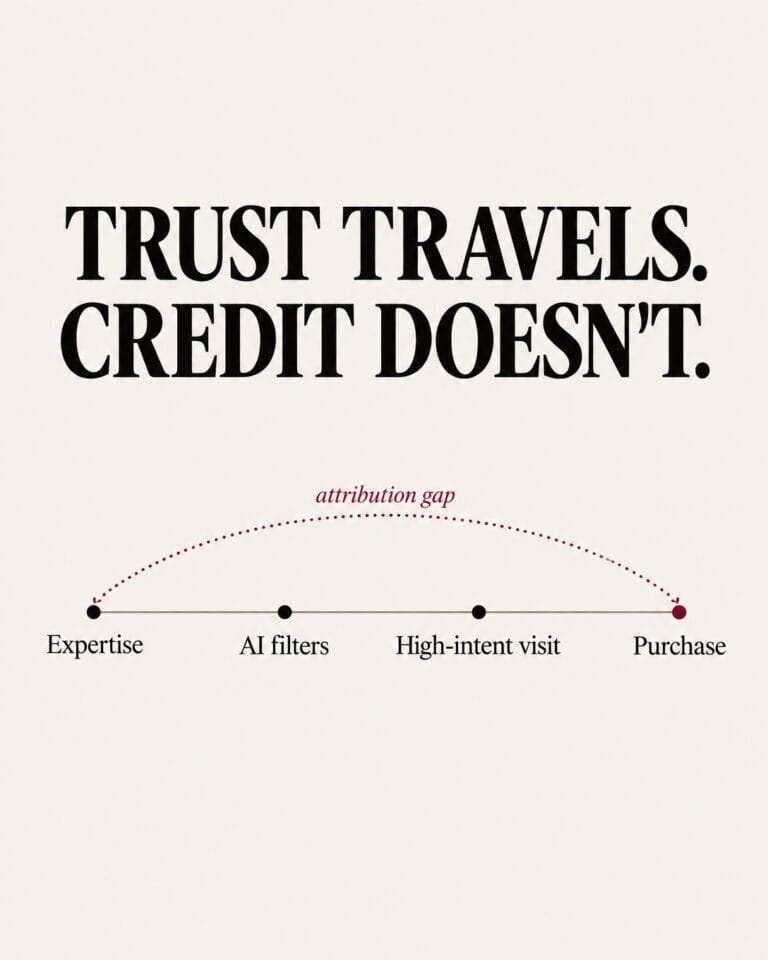
Cross-device journeys happen. People discover you through one partner and convert later through another channel. Buyers forward links internally. Sales teams close deals weeks later. Coupon and toolbar partners can appear at the end of journeys they did not create. Last-click attribution can make the final touch look much more important than it was.
Influencer attribution is usually messier because the content itself can change awareness, branded search, direct traffic, consideration, and offline conversation without producing a tidy click path.
So I would measure both channels with more than one signal: tracked conversions where you have them, unique links or codes, CRM source data, assisted conversions, branded search movement, direct traffic, content engagement, and qualitative feedback from prospects and customers.
The measurement window should match the buying cycle. A B2B SaaS product with a considered purchase process needs a different read than a low-cost consumer product someone buys ten minutes after seeing it.
The Hybrid Model Is Often More Useful Than the Label
You do not always need to choose one compensation model forever.
A creator can be paid a flat fee for the work required to make and distribute the content, then earn commission on the customers or qualified opportunities they influence. That gives the creator guaranteed compensation for the production work while preserving upside when the partnership performs.
For some partners, I would do the opposite: start with performance economics, then add paid placements once the relationship has already shown commercial value.
The point is not that hybrid is automatically better. It is that “influencer” and “affiliate” are increasingly poor descriptions of what a valuable partner can actually do.
A single person can create awareness, educate the market, influence consideration, and generate attributable revenue. Your compensation model should reflect which of those jobs you are asking them to do.
What I Would Test in B2B SaaS
I would not start with an arbitrary rule like “run five creators for six weeks.” The right pilot depends on deal size, buying cycle, content format, audience size, and how quickly the outcome you care about can realistically appear.
I would start small enough that the business can learn without pretending a weak first test proves the channel does not work.
Before launch, define:
- the job you are hiring the partner to do;
- the audience you expect them to influence;
- the compensation model and why it matches the job;
- the signals you will use to judge performance;
- the point at which you will decide to expand, change, or stop the test.
Then let the buying cycle dictate how long you need before making the call.
Do Not Scale Around an Activation Problem
This is the part where affiliate program management comes back into the picture.
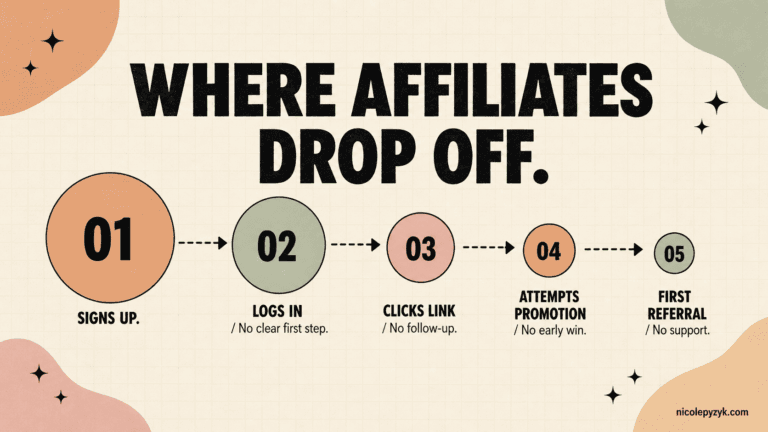
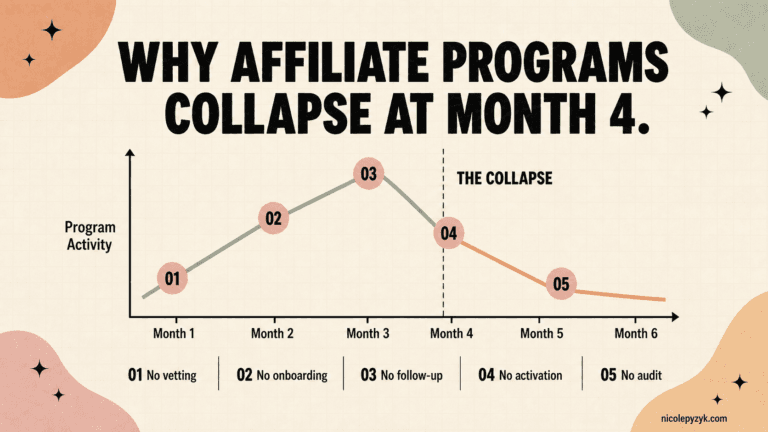
If you have 200 partners and 15 producing revenue, recruiting another hundred before understanding the other 185 is usually how you get the same problem at a larger scale.
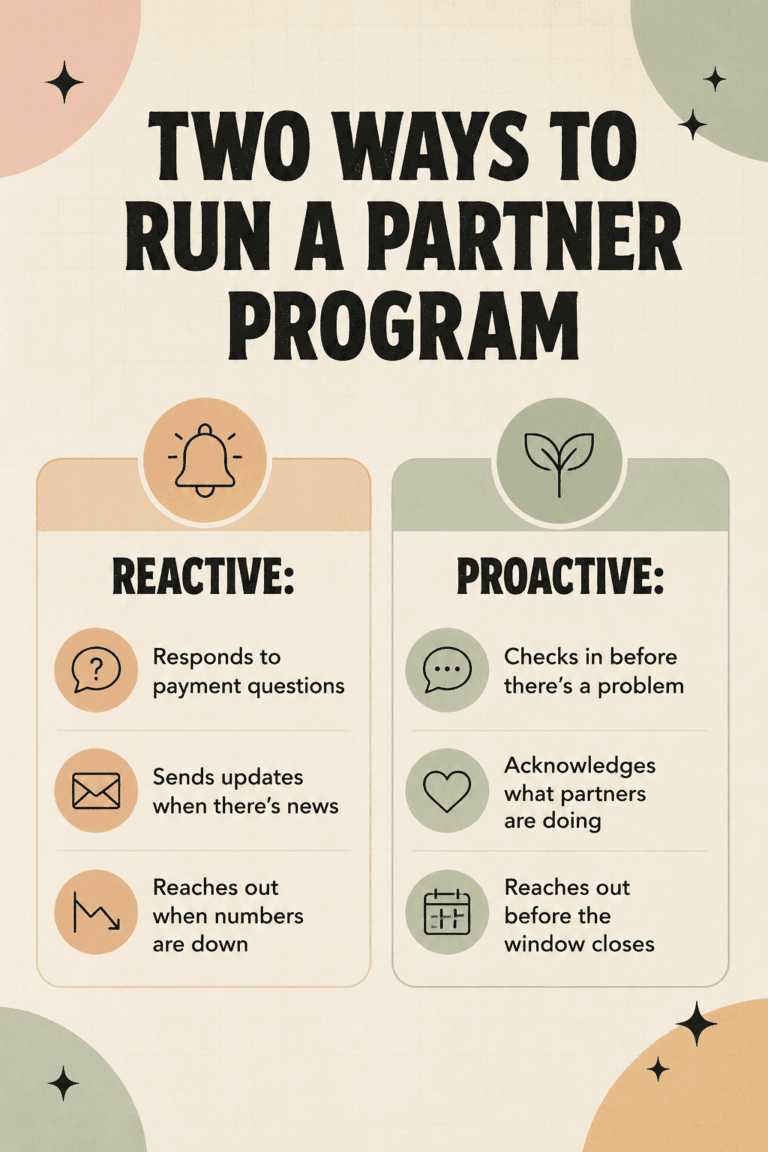
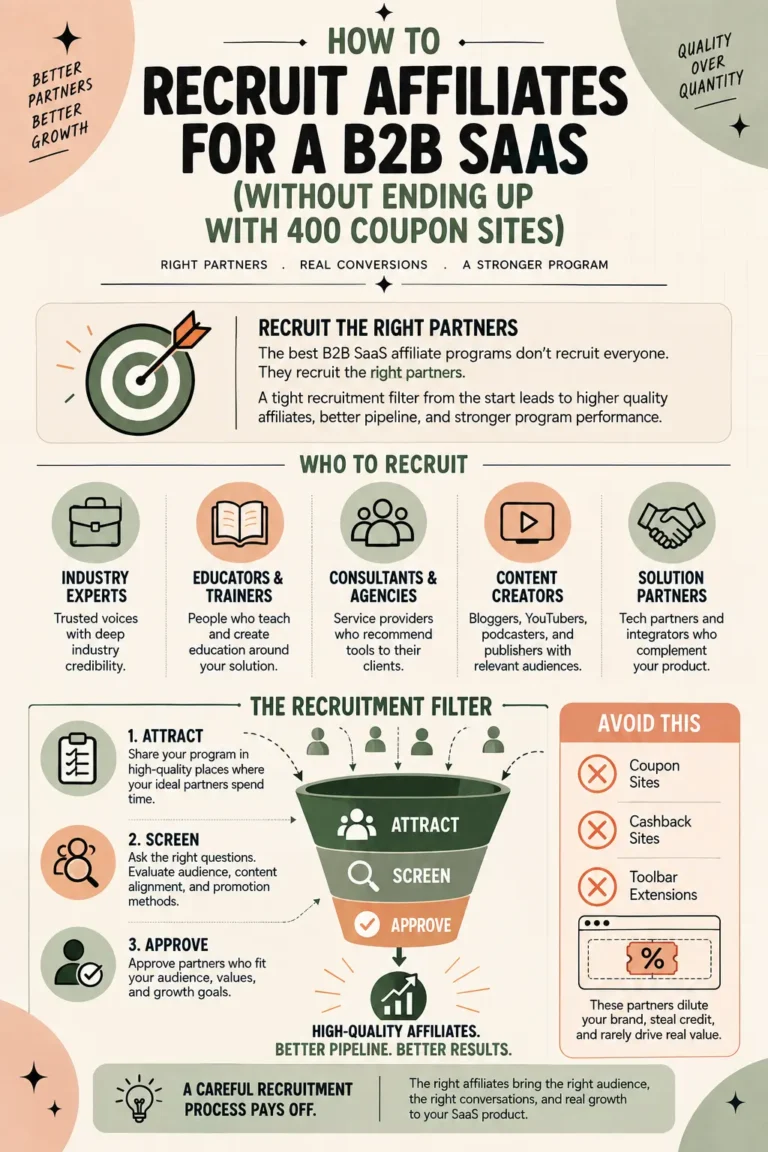
Before adding more partners, I would want to know whether the issue is partner quality, onboarding, economics, enablement, tracking, communication, or the offer itself. That is why I separate recruitment from activation. A weak recruitment filter and a weak activation system can both produce a partner list full of silence, but they are not the same problem.
If the program is already messy enough that you cannot tell which one you have, start with an affiliate program audit before putting more budget into either channel.
So, Influencer or Affiliate?
The decision is not really “which channel is better?”
It is:
- What are you asking this partner to do?
- What are you willing to pay for?
- How much outcome risk can the business carry?
- How will you know whether the partnership worked?
Answer those four questions and the compensation model usually gets much easier to choose.
B2B SaaS Affiliate Program Audit Checklist
If you cannot tell whether the real problem is partner quality, activation, economics, tracking or infrastructure, use the checklist to work through it before adding more volume.
You’ll also receive occasional B2B SaaS affiliate program notes. Unsubscribe anytime.