
Most affiliate programs don’t have a recruitment problem. They have a dormancy problem they’ve been solving with more recruitment — which makes the underlying problem worse.
If your program has hundreds or thousands of registered partners and a promotion rate that makes you wince, the answer isn’t a new recruitment campaign. It’s an audit. And not the kind that produces a dashboard screenshot and a quarterly report — the kind that tells you which partners are worth your time and which ones are quietly dragging your activation rate into the floor.
I’ve run this process on a real B2B SaaS program. The list started at nearly 4,000 registered partners. It ended at just under 300. Activation rate improved. The program got smaller and more effective at the same time. That’s what this article is about.
Most Affiliate Programs Don’t Have a Recruitment Problem
When performance is flat, the instinct is to recruit more. More partners means more chances for a conversion, right?
In theory. In practice, a bloated partner list makes it nearly impossible to run a focused activation campaign. You can’t personalize outreach at scale when your “scale” is 3,800 people who haven’t opened an email in eight months. You end up broadcasting to everyone and reaching no one.
The real question isn’t “how do we get more partners?” It’s “why aren’t the partners we already have doing anything?” Those are different problems with different solutions. Conflating them is how programs end up with impressive registration numbers and embarrassing conversion data.
An audit is the diagnostic that separates the two.
What “Dormant” Actually Means (and Why It’s Not Always the Partner’s Fault)
There’s a distinction worth making before you start cutting: dormant partners are not all the same.
Some signed up with genuine intent and disengaged because the program didn’t give them what they needed — no onboarding, no assets, no clear path to a first commission. That’s a program design failure, not a partner failure. These people might be recoverable.
Others were never a real fit. They signed up through a mass recruitment push, got approved automatically, and never had any meaningful reason to promote. No amount of re-engagement will fix a fundamental mismatch between their audience and your product.
The audit has to distinguish between these two groups. The response to each is completely different.
What a Real Affiliate Program Audit Actually Looks At
An audit is a diagnostic process, not a reporting exercise. The goal isn’t to produce metrics — it’s to answer specific questions about why the program is performing the way it is.
There are four areas worth examining:
- Partner fit. Were these partners ever the right people to be promoting this product? Do they have an audience that would actually buy it? (This includes compliance posture — partners should be genuinely disclosing and promoting appropriately per FTC endorsement guidelines.)
- Engagement signals. Has this partner opened an email, clicked a link, or generated a single conversion in the last 90 days? Zero signal across all three is meaningful data.
- Program infrastructure. Are the tracking links working? Are the creative assets current and usable? Is the commission structure competitive? Sometimes dormancy is a symptom of a broken program, not a disengaged partner.
- Commission structure. Is there a reason a motivated partner would stay inactive? If the payout is low, the cookie window is short, or the attribution model is confusing, fix that before you blame the partners.
How to Audit an Affiliate Program Without Drowning in a Spreadsheet
Pull your partner data from whatever platform you’re using — PartnerStack, Rewardful, Tapfiliate, or wherever your program live, and build a simple segmentation. You don’t need 40 columns.
The columns that matter:
- Date joined
- Last login (if available)
- Emails opened in the last 90 days
- Clicks generated in the last 90 days
- Conversions all-time
- Conversions in the last 90 days
Set your active window at 90 days for B2B SaaS. Longer sales cycles mean you’re not expecting weekly conversions — but you should still see some signal. A partner who has never opened an email and has zero clicks in 90 days is dormant by any reasonable definition.
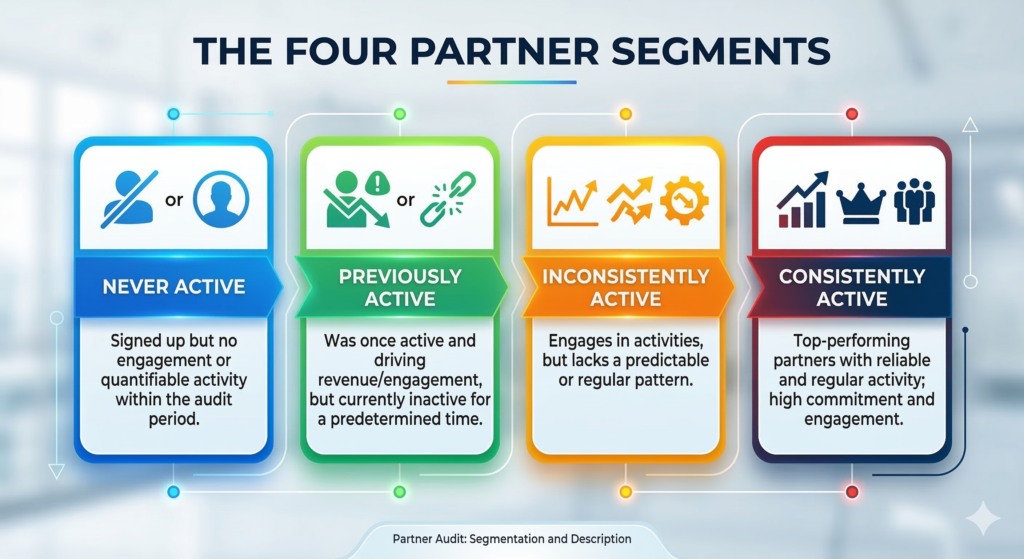
Segment the list into four buckets before you make any decisions: never active, previously active but lapsed, inconsistently active, and consistently active. Each bucket gets a different response.
The Questions the Audit Is Actually Trying to Answer
Think of the audit as a series of diagnostic questions, not a metrics review:
- Who has never done anything — no clicks, no opens, no conversions, ever?
- Who did something once and stopped? What happened around that time?
- Who is active but underperforming relative to their audience size?
- Who is active and performing well — and what do they have in common?
That last question is the most useful one. The partners who are working tell you exactly what the program should be optimized for. The partners who have never done anything tell you where your recruitment criteria broke down.
How to Clean Your Affiliate List Without Burning Bridges
Once the audit surfaces the dormant partners, the question becomes: what do you actually do with them?
The answer depends on which bucket they’re in.
Partners who were once active and lapsed are worth a re-engagement attempt. One. Partners who signed up through a mass campaign, have never generated a click, and have no obvious connection to your product’s audience are not worth the effort. Cut them.
The goal is a list you can actually run campaigns against — not a list that looks impressive in a registration count.
The Re-Engagement Attempt — What It Should and Shouldn’t Include
A re-engagement message to a dormant partner should be short, honest, and low-friction. One email. One question. One clear next step.
It should not look like a newsletter. It should not include a product update, a new feature announcement, or anything that reads like a broadcast. If it could have been sent to 500 people at once, it will feel like it was — and it won’t work.
Something like: “Hey [name], I noticed you haven’t had a chance to promote [product] yet. Is there something missing that would make it easier to get started? Happy to jump on a quick call or send over whatever you need.”
That’s it. If they don’t respond, you have your answer.
When to Cut Without Reaching Out
There are cases where re-engagement isn’t worth the effort and you should skip it entirely:
- Partners who signed up through a mass recruitment campaign with no personal contact
- Partners whose audience is clearly misaligned with your product
- Partners who have been inactive for 12+ months with zero signal across all engagement metrics
- Partners who were approved automatically with no vetting
Removing these partners isn’t burning a bridge. There was no bridge. A clean list is a functional list, and a functional list is the only kind you can actually activate.
What Happens to Activation Rate When You Cut the Dead Weight
This is where the math gets interesting — and where most program managers have the wrong instinct.
Cutting partners feels like losing ground. The registration number goes down. The program looks smaller. It is smaller. That’s the point.
Activation rate is calculated as the percentage of registered partners who have generated at least one conversion. When your denominator is 4,000 dormant partners, even a well-run program looks broken. When your denominator is 300 genuinely relevant partners, the same number of active promoters produces a rate that reflects what the program is actually doing.
I ran this exact process on one client program. Nearly 4,000 registered partners, audited and cleaned down to just under 300. Activation rate improved significantly — not because we did anything magical with the remaining partners, but because the remaining partners were actually targetable. We could run focused campaigns. We could personalize outreach. We could identify what the active partners had in common and use that to sharpen recruitment going forward.
The program got smaller and more effective at the same time. That’s not a coincidence.
Why a Smaller Active Program Outperforms a Large Dormant One
A list of 300 partners you can reach, segment, and run campaigns against is worth more than 4,000 names in a database that no outreach effort can meaningfully touch.
This isn’t just about activation rate as a vanity metric. It’s about where your time goes. Every hour spent trying to re-engage a partner who was never a fit is an hour not spent supporting a partner who is actively promoting and could be doing more.
The audit doesn’t just clean the list. It tells you where to focus.
What to Do With the Partners Who Remain
Once the list is clean, the activation effort that was previously impossible becomes manageable.
Segment the remaining partners by type — content creators, agencies, complementary SaaS tools, consultants, whatever categories are relevant to your program. Each type needs a different approach and different assets.
For the partners who have shown some signal but haven’t converted yet, a sequenced outreach approach works better than a one-off email. Check in, offer something useful, ask a specific question. Move them toward a first conversion, not toward opening a newsletter.
“Activated” should mean something specific and measurable: at least one conversion generated within a defined window. Not “opened an email.” Not “clicked a link.” A conversion. That’s the outcome the activation effort is working toward.
The full activation playbook — sequences, segmentation, what to send and when — is a separate topic. But it only becomes possible once the list underneath it is clean.
How Often Should You Run an Affiliate Program Audit?
A light quarterly review is enough to catch drift before it compounds. Check engagement signals, flag partners who have gone quiet, and keep the list from ballooning back up.
A full audit — the kind that involves real segmentation decisions and list cleaning — should happen at least once a year. It should also happen any time the program changes significantly: new commission structure, new product tier, new ICP, new tracking platform.
The 4,000-partner problem doesn’t happen overnight. It accumulates over years of approving applications without vetting, running recruitment campaigns without follow-through, and never asking why the activation rate keeps dropping. A regular audit is what prevents it from happening again.
FAQ
A bloated affiliate list isn’t a sign that your program is growing — it’s a sign that growth and quality have come apart. The audit is how you reconnect them.
If you’re managing a B2B SaaS affiliate program and the numbers aren’t reflecting the effort you’re putting in, it’s worth taking a hard look at what’s actually in the list before you add anything else to it. I work with programs on exactly this at Affilial.com — if that’s where you are, come take a look.